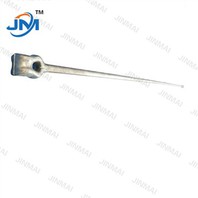
Hey there! I'm a supplier of Pole Line Hardware, and I've been in this industry for quite a while. One question I often get asked is, "Are there any new technologies in pole line hardware manufacturing?" Well, you bet there are! In this blog, I'm gonna share some of the latest tech advancements that are revolutionizing the way we make pole line hardware.
Let's start with materials. In the past, we mainly used traditional materials like steel and aluminum. But now, there are some new kids on the block. For example, composite materials are becoming more and more popular. These materials are made by combining different substances to get the best properties from each. They're lightweight, which makes them easier to transport and install. At the same time, they're also highly resistant to corrosion, which is a big deal in the outdoor environment where pole line hardware is often used.


One of the composite materials I'm really excited about is fiberglass - reinforced polymers. They can withstand harsh weather conditions, including extreme temperatures and high humidity. This means that the pole line hardware made from these materials will have a longer lifespan. And let's face it, longer - lasting hardware means less maintenance and replacement costs for our customers.
Another area where new technologies are making a big impact is in the manufacturing process itself. Computer - Numerical - Control (CNC) machining has been around for a while, but it's getting even better. With CNC machines, we can achieve a much higher level of precision. We can create parts with very tight tolerances, which is crucial for the proper functioning of pole line hardware. For instance, when making Electricity Pole Line Hardware For Power Transmission Eye Bolts, the accuracy of the threading and the size of the eye are extremely important. CNC machining ensures that each bolt meets the exact specifications.
3D printing is also starting to find its way into pole line hardware manufacturing. This technology allows us to create complex shapes that would be difficult or impossible to make with traditional manufacturing methods. We can quickly produce prototypes, which speeds up the product development process. If we want to test a new design for a cable clamp, we can use 3D printing to make a sample in a matter of hours instead of days or weeks with traditional methods.
Surface treatment technologies have also advanced significantly. Hot - dip galvanizing has been a standard way to protect steel hardware from rust for a long time. But now, there are new types of coatings that offer even better protection. For example, Hot Dip Galvanized Angle Steel is already well - protected, but some new nanocoatings can further enhance its corrosion resistance. These nanocoatings can be applied very thinly, which doesn't add much weight to the hardware, but they can form a very strong barrier against moisture and other corrosive agents.
In the area of plastic pole line hardware, there are some cool new developments too. Take Plastic Overhead Line Cable Anchor Clamp For ADSS Cable for example. New plastic materials are being developed that have better mechanical properties. They're stronger and more flexible at the same time. This allows the clamps to hold the cables securely without causing damage to the cable insulation.
Smart technology is also making its way into pole line hardware. We're starting to see the integration of sensors into some of our products. These sensors can monitor things like temperature, vibration, and stress. For example, if a pole is under too much stress due to strong winds or an overloaded line, the sensor can send an alert. This early warning system can help prevent failures and outages, which is a huge benefit for power utilities.
The use of automation in the manufacturing process is on the rise. Automated assembly lines can put together pole line hardware much faster and more accurately than human workers. Robots can handle repetitive tasks with high precision, which reduces the chance of errors. This not only increases productivity but also improves the quality of the final products.
When it comes to quality control, new technologies are making it easier and more reliable. Non - destructive testing methods, such as ultrasonic testing and X - ray inspection, are being used more widely. These methods allow us to check the internal structure of the hardware without damaging it. We can detect any hidden defects, like cracks or voids, which could lead to failures in the future.
So, as you can see, there are plenty of new technologies in pole line hardware manufacturing. These advancements are not only improving the quality and performance of our products but also making the manufacturing process more efficient and cost - effective.
If you're in the market for pole line hardware, I encourage you to reach out. Whether you're a power utility, a contractor, or anyone else in need of high - quality pole line hardware, we can provide you with the latest products that incorporate these new technologies. Contact us to start a conversation about your specific needs and let's see how we can work together to find the best solutions for you.
References
- "Advanced Materials in Power Transmission Infrastructure" - Journal of Power Engineering
- "The Future of Manufacturing: Technologies Shaping the Industry" - Manufacturing Today Magazine
- "Smart Sensors in Electrical Infrastructure" - Electrical Technology Review