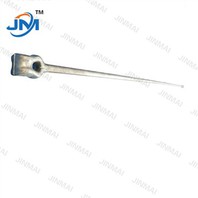
Yo, what's up everyone! I'm a supplier of overhead line fittings, and today I wanna chat about how new overhead line fitting designs are really upping the game when it comes to performance.
Let's start by understanding what overhead line fittings are all about. These are the components that are used to support, connect, and protect the conductors and other equipment on overhead power lines. From insulators to clamps, each fitting plays a crucial role in ensuring the safe and efficient transmission of electricity.
So, how exactly do new designs improve performance? Well, one of the key areas is in materials. In the past, many fittings were made from basic metals that were prone to corrosion and wear. But now, we're seeing a shift towards more advanced materials. For example, Hot Dip Galvanized Overhead Line Hardware has become super popular. The hot - dip galvanizing process creates a thick, protective zinc coating on the metal. This coating acts as a barrier, preventing moisture and oxygen from reaching the underlying metal. As a result, the fittings are much more resistant to rust and corrosion, which means they last longer. No more having to replace fittings every few years due to rust damage. This not only saves money in the long run but also reduces the downtime for power lines during maintenance and replacement.
Another aspect of new designs is in the area of flexibility. Traditional fittings were often rigid and didn't adapt well to changes in the environment. But modern designs are much more flexible. Take the Hot Dip Galvanized Secondary Clevis for example. These clevises are designed to allow for a certain degree of movement. This is really important because power lines are constantly exposed to wind, temperature changes, and even seismic activity. The flexibility of these fittings helps to absorb the stresses caused by these external factors. Instead of breaking under pressure, the fitting can bend and flex, which reduces the risk of line failures. It also means that the power lines can better withstand extreme weather conditions, like strong winds or heavy snow.
When it comes to installation, new designs are also a game - changer. In the old days, installing overhead line fittings could be a real pain in the neck. It often required a lot of tools and a high level of skill. But now, manufacturers have come up with designs that are much easier to install. For instance, some new clamps have a simple, one - piece design that can be quickly attached to the conductors. This not only speeds up the installation process but also reduces the chances of errors during installation. And let's face it, a correctly installed fitting is much more likely to perform well over time.
New designs also focus on improving the electrical performance of the fittings. In power transmission, any loss of electricity is a big deal. Old - style fittings sometimes had poor electrical conductivity, which led to energy losses. But new designs use materials and shapes that are optimized for electrical flow. For example, some fittings are designed with smooth surfaces and precise geometries to minimize resistance. This means that more of the electricity can flow through the lines without being wasted as heat. As a result, the overall efficiency of the power transmission system is improved.
Now, let's talk about the impact on safety. Safety is always a top priority when it comes to overhead power lines. New fitting designs have incorporated several safety features. Some fittings are designed to prevent accidental contact with live parts. They have guards and shields that cover the electrical connections, reducing the risk of electric shocks for maintenance workers. Also, the improved durability and flexibility of the fittings mean that there is less chance of sudden failures, which could cause power outages or even more serious accidents.
In the field of Electric Power Stringing, new fitting designs are making the process much more efficient. Power stringing is the process of installing the conductors on the overhead lines. New fittings are designed to work seamlessly with modern stringing equipment. They can be easily attached to the pulling ropes and other tools, which speeds up the entire stringing process. This is especially important when building new power lines or upgrading existing ones.
Overall, the new overhead line fitting designs are a huge step forward. They offer better durability, flexibility, electrical performance, and safety. Whether you're a power company looking to upgrade your existing lines or a contractor building new ones, these new fittings are definitely worth considering.
If you're interested in learning more about our overhead line fittings or want to start a procurement discussion, don't hesitate to reach out. We're always happy to chat and help you find the right fittings for your specific needs.


References:
- Electrical Transmission and Distribution Handbook by Thomas A. Short
- Overhead Power Line Engineering by W. H. Kersting