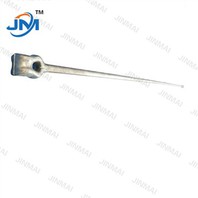
When it comes to installing and maintaining cables, one crucial component that often goes unnoticed is the cable pole hook. As a reliable cable pole hook supplier, I understand the importance of ensuring that these hooks are capable of bearing the appropriate load. In this blog, I'll delve into the key factors and steps involved in calculating the load capacity needed for a cable pole hook, ensuring a safe and efficient cable installation.
Understanding the Basics of Load Capacity
Before we start the calculation, it's essential to understand what load capacity means. Load capacity refers to the maximum amount of weight or force that a cable pole hook can safely support without failing. This includes not only the weight of the cables themselves but also any additional forces such as wind, ice, and vibrations. A hook with insufficient load capacity can lead to structural failure, which can cause cables to fall, disrupt service, and even pose a safety hazard.
Factors Affecting Load Capacity
Cable Weight
The weight of the cables is the most obvious factor affecting the load on a cable pole hook. Different types of cables have different weights per unit length. For example, coaxial cables are generally lighter than power cables. To calculate the weight of the cables, you need to know the type of cable, its length, and its weight per unit length. You can usually find the weight per unit length in the cable's technical specifications.
Number of Cables
The more cables you hang on a single hook, the greater the load. It's important to consider the number of cables that will be attached to each hook when calculating the load capacity. Additionally, the arrangement of the cables can also affect the load distribution. For instance, if the cables are bunched together, the load may be concentrated in one area, while a more evenly spaced arrangement can distribute the load more evenly.
Environmental Factors
Environmental factors play a significant role in determining the load on a cable pole hook. Wind can exert a lateral force on the cables, increasing the overall load on the hook. Ice accumulation can add significant weight to the cables, especially in regions with cold climates. Vibrations caused by traffic, wind, or other sources can also fatigue the hook over time, reducing its effective load capacity.
Safety Factor
A safety factor is a multiplier applied to the calculated load to account for uncertainties and potential variations in the actual load. It's a crucial consideration to ensure the long - term safety and reliability of the installation. A common safety factor for cable pole hooks is between 1.5 and 2. This means that the hook should be rated to carry 1.5 to 2 times the calculated load.
Calculating the Load Capacity
Step 1: Determine the Weight of the Cables
First, find the weight per unit length of each type of cable. Multiply this by the length of the cable to get the total weight of each cable. Then, sum up the weights of all the cables that will be attached to the hook.
For example, if you have two types of cables:
- Cable A has a weight per unit length of 0.5 kg/m and a length of 10 m. Its weight is 0.5 kg/m × 10 m = 5 kg.
- Cable B has a weight per unit length of 0.8 kg/m and a length of 15 m. Its weight is 0.8 kg/m × 15 m = 12 kg.
The total weight of the cables is 5 kg+12 kg = 17 kg.
Step 2: Account for Environmental Loads
Estimate the additional load due to environmental factors such as wind and ice. This can be a complex calculation that may require the use of engineering standards and local weather data. For example, if you expect ice to accumulate on the cables and based on local historical data, you estimate that the ice will add an additional 5 kg to the total weight of the cables. So the new total load becomes 17 kg + 5 kg = 22 kg.
Step 3: Apply the Safety Factor
Multiply the total load (including environmental factors) by the safety factor. If we use a safety factor of 1.5, the required load capacity of the hook is 22 kg × 1.5 = 33 kg.
Selecting the Right Cable Pole Hook
Once you have calculated the required load capacity, it's time to select the appropriate cable pole hook. As a cable pole hook supplier, I offer a wide range of hooks with different load capacities to meet various needs.
- Pig tail ball head: This type of hook, available at Pig tail ball head, is designed for specific applications where a flexible connection is required. It can be used in situations where the cables need to move slightly without causing excessive stress on the hook.
- Hardware Pole Line Hook: The Hardware Pole Line Hook is a sturdy and reliable option for heavy - duty applications. It is capable of withstanding high loads and is suitable for use in areas with harsh environmental conditions.
- Cable Pole Hook: Our Cable Pole Hook is a versatile option that can be used in a variety of cable installation scenarios. It comes in different sizes and load capacities to accommodate different requirements.
Conclusion
Calculating the load capacity needed for a cable pole hook is a critical step in ensuring a safe and reliable cable installation. By considering factors such as cable weight, number of cables, environmental factors, and applying an appropriate safety factor, you can accurately determine the required load capacity. As a cable pole hook supplier, I am committed to providing high - quality hooks that meet your specific load requirements.


If you're in the process of planning a cable installation or need to replace existing hooks, I encourage you to reach out for a detailed discussion about your needs. We can work together to select the right cable pole hooks for your project, ensuring optimal performance and safety.
References
- Engineering Standards for Cable Installations, Published by National Electrical Safety Code
- Cable Manufacturer's Technical Specifications