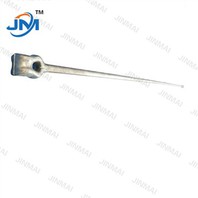
Hey there! As a supplier of pole line hardware, I've been dealing with these nifty pieces of equipment for ages. Today, I'm gonna dive into the electrical properties of pole line hardware. It's not just about the physical strength and durability; the electrical side is super important too.
Let's start with the basics. Pole line hardware is used in electrical power distribution and transmission systems. These systems are responsible for getting electricity from power plants to our homes and businesses. And the hardware we supply plays a crucial role in making sure that electricity flows smoothly and safely.
One of the key electrical properties we need to consider is conductivity. Conductivity is a measure of how well a material allows electricity to flow through it. In pole line hardware, we often use metals like aluminum and copper because they have high conductivity. For example, aluminum is lightweight and has good conductivity, which makes it a popular choice for overhead power lines. Copper, on the other hand, has even higher conductivity and is often used in more critical applications where low resistance is essential.
But it's not just about having high conductivity. We also need to think about resistance. Resistance is the opposite of conductivity. It's a measure of how much a material opposes the flow of electricity. When electricity flows through a material with resistance, some of the electrical energy is converted into heat. This is why it's important to keep resistance as low as possible in pole line hardware. If the resistance is too high, it can lead to energy losses and even overheating, which can be a safety hazard.
Another important electrical property is insulation. Insulation is used to prevent electricity from flowing where it's not supposed to. In pole line hardware, insulators are used to support and separate electrical conductors while preventing current from flowing through the supporting structures. For instance, the Nylon Steel Insulator Pole Top Pin is designed to provide good insulation and mechanical support for overhead power lines. It's made of a combination of nylon and steel, which gives it both electrical and mechanical properties.
Dielectric strength is also a crucial factor. Dielectric strength is the maximum electric field that an insulating material can withstand without breaking down and allowing current to flow through it. A high dielectric strength means that the insulator can withstand higher voltages without failing. This is especially important in high-voltage power transmission systems, where the voltages can be extremely high.
Let's talk about some specific types of pole line hardware and their electrical properties. The Thimble Eyelet is a small but important part. It's usually made of metal and is used to provide a smooth, reinforced hole for a wire or cable to pass through. The metal used in the thimble eyelet should have good conductivity to ensure that there's minimal resistance when the wire is passing through. At the same time, it should also be able to withstand the mechanical stress caused by the wire's movement.
The Triple Eye Anchor Rod is another interesting piece of hardware. It's used to anchor poles and other structures in the ground. From an electrical perspective, the anchor rod needs to be properly grounded. Grounding is the process of connecting an electrical circuit or equipment to the earth. It helps to protect against electrical faults and lightning strikes. The anchor rod should have low resistance to the ground to ensure that any electrical current can safely flow into the earth.
Corrosion resistance is also related to the electrical properties of pole line hardware. When metal hardware corrodes, it can increase the resistance of the electrical connection. This can lead to energy losses and potential safety issues. That's why we often use materials that are resistant to corrosion, such as galvanized steel. Galvanized steel has a layer of zinc coating that protects the underlying steel from rust and corrosion.
In addition to these properties, we also need to consider the environmental conditions in which the pole line hardware will be used. For example, in areas with high humidity or saltwater exposure, the hardware needs to be more resistant to corrosion. In areas with extreme temperatures, the materials need to be able to maintain their electrical and mechanical properties over a wide range of temperatures.
Now, you might be wondering how we test the electrical properties of pole line hardware. Well, there are several methods. One common method is to measure the resistance of the hardware using a multimeter. This gives us an idea of how well the material conducts electricity. We also use high-voltage testing to check the dielectric strength of insulators. This involves applying a high voltage to the insulator and monitoring for any signs of breakdown.
As a supplier of pole line hardware, we take great care in ensuring that our products meet the highest standards of electrical performance. We work closely with manufacturers to source the best materials and use the latest manufacturing techniques. Our goal is to provide our customers with reliable, high-quality pole line hardware that will perform well in their electrical systems.


If you're in the market for pole line hardware, whether you're an electrical contractor, a utility company, or someone involved in a DIY electrical project, we'd love to hear from you. We have a wide range of products to meet your needs, and we can offer expert advice on choosing the right hardware for your specific application. Contact us to start a discussion about your requirements and let's work together to find the perfect pole line hardware solutions for you.
References
- Electrical Engineering Handbook, Third Edition
- Power System Engineering Textbooks