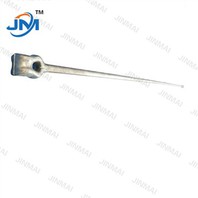
The brittleness of a pigtail eye bolt is a critical characteristic that directly impacts its performance, durability, and safety in various applications. As a trusted supplier of pigtail eye bolts, I understand the significance of comprehending this property to ensure the best selection and use of these products.


Understanding Pigtail Eye Bolts
Pigtail eye bolts are specialized fasteners commonly used in electrical, mechanical, and construction industries. They feature a looped end (the "eye") and a threaded shank, often with a bent or curved section resembling a pigtail. These bolts are designed to provide a secure attachment point for cables, ropes, or other components. For instance, in electrical installations, they are used to support and route cables, while in mechanical setups, they can be used for lifting or securing equipment. You can explore our range of Pig tail ball head on our website.
Defining Brittleness
Brittleness is a material property that describes how a material behaves under stress. A brittle material is one that fractures or breaks with little or no plastic deformation when subjected to a load. In the context of pigtail eye bolts, brittleness can lead to sudden and unexpected failure, which can have serious consequences, especially in applications where safety is paramount.
Factors Affecting the Brittleness of Pigtail Eye Bolts
Material Composition
The type of material used to manufacture pigtail eye bolts plays a significant role in determining their brittleness. Common materials include carbon steel, stainless steel, and alloy steel. Carbon steel, for example, can be prone to brittleness, especially if it has a high carbon content. High - carbon steels are stronger but more brittle compared to low - carbon steels. Stainless steel, on the other hand, is generally more corrosion - resistant and can have better ductility, reducing the risk of brittleness. Alloy steels are engineered to have specific properties, and the addition of elements such as nickel, chromium, and molybdenum can enhance toughness and reduce brittleness.
Heat Treatment
Heat treatment processes are used to modify the mechanical properties of pigtail eye bolts. Improper heat treatment can result in increased brittleness. For example, if a bolt is quenched too rapidly during the heat treatment process, it can develop internal stresses and a brittle microstructure. On the contrary, proper tempering after quenching can relieve these stresses and improve the bolt's toughness.
Manufacturing Processes
The manufacturing processes involved in producing pigtail eye bolts can also affect their brittleness. Cold - working processes, such as cold forging or cold heading, can increase the strength of the bolt but may also introduce residual stresses that can contribute to brittleness. Machining operations, if not carried out correctly, can create surface defects or stress concentrations that can act as initiation points for cracks and subsequent brittle failure.
Consequences of Brittleness in Pigtail Eye Bolts
Safety Risks
In applications where pigtail eye bolts are used to support heavy loads or in critical systems, brittleness can pose a significant safety risk. A sudden failure of a brittle bolt can lead to the collapse of structures, equipment damage, or even endanger human lives. For example, in a power transmission line, a brittle pigtail eye bolt used to support cables could break under normal operating conditions or during a minor overload, causing the cables to fall and potentially disrupt power supply or cause electrocution hazards.
Reduced Service Life
Brittle pigtail eye bolts are more likely to develop cracks and fractures over time, even under normal operating conditions. These cracks can propagate rapidly, leading to premature failure of the bolt. This not only requires frequent replacement of the bolts but also increases maintenance costs and downtime for the equipment or structure in which they are used.
Testing for Brittleness
Impact Testing
One of the common methods to assess the brittleness of pigtail eye bolts is through impact testing. The Charpy or Izod impact tests are widely used. In these tests, a notched specimen of the bolt material is subjected to a sudden impact load. The energy absorbed during the fracture is measured, and a lower energy absorption indicates a more brittle material.
Hardness Testing
Hardness testing can also provide an indication of brittleness. Generally, a very high hardness value may suggest increased brittleness. Rockwell or Brinell hardness tests are commonly used to measure the hardness of pigtail eye bolts. However, it should be noted that hardness is not the only factor determining brittleness, and other factors such as microstructure also need to be considered.
Mitigating Brittleness in Pigtail Eye Bolts
Material Selection
Choosing the right material is crucial in reducing the brittleness of pigtail eye bolts. As a supplier, we offer a wide range of materials with different properties to suit various applications. For applications where toughness is critical, we recommend using low - carbon steels or stainless steels. For high - strength requirements, alloy steels with appropriate alloying elements can be selected.
Quality Control in Manufacturing
Implementing strict quality control measures during the manufacturing process is essential to minimize brittleness. This includes proper heat treatment processes, careful control of cold - working operations, and thorough inspection of the finished bolts for surface defects and internal stresses. Our manufacturing facilities adhere to international standards and best practices to ensure the highest quality of our pigtail eye bolts.
Regular Inspection and Maintenance
Regular inspection of pigtail eye bolts in service can help detect early signs of brittleness or damage. Visual inspection for cracks, deformation, or corrosion can be carried out, and non - destructive testing methods such as ultrasonic testing or magnetic particle testing can be used to detect internal defects. If any signs of brittleness or damage are detected, the bolts should be replaced immediately.
Related Products and Their Interaction with Pigtail Eye Bolts
In addition to pigtail eye bolts, we also supply other related cable components such as Hardware Pole Line Hook and Pigtail Hook Bolts. These products often work in conjunction with pigtail eye bolts in various applications. For example, a hardware pole line hook can be used in combination with a pigtail eye bolt to secure cables to poles. It is important to ensure that all these components are compatible in terms of material properties and load - bearing capacities to avoid any issues related to brittleness or other mechanical failures.
Conclusion
The brittleness of pigtail eye bolts is a complex issue that is influenced by multiple factors, including material composition, heat treatment, and manufacturing processes. Understanding the causes and consequences of brittleness is crucial for ensuring the safe and reliable use of these bolts in various applications. As a supplier, we are committed to providing high - quality pigtail eye bolts with minimal brittleness through careful material selection, strict quality control, and continuous improvement of our manufacturing processes.
If you are in need of pigtail eye bolts or other cable components, we invite you to contact us for a detailed discussion about your specific requirements. Our team of experts is ready to assist you in selecting the right products for your applications and ensuring their optimal performance.
References
- ASM Handbook Volume 1: Properties and Selection: Irons, Steels, and High - Performance Alloys.
- Mechanical Engineering Design by Joseph E. Shigley, Charles R. Mischke, and Richard G. Budynas.
- Standards for Fasteners and Related Products by ASTM International.