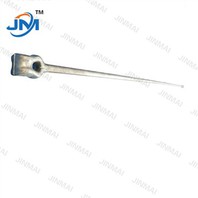
Yo, what's up! I'm a supplier of Insulator Spindles, and today I wanna chat about something super important in our field - the electrical breakdown voltage of an insulator spindle.
So, first things first, what exactly is electrical breakdown voltage? Well, in simple terms, it's the voltage at which an insulator loses its insulating properties and starts to conduct electricity. You can think of it like a wall that's supposed to keep water out. But when the water pressure gets too high, the wall breaks, and water starts flowing through. Similarly, when the voltage across an insulator spindle gets too high, the insulator breaks down, and current can pass through it.

Now, why is this breakdown voltage such a big deal? For us in the insulator spindle business, it's crucial because it determines the safety and reliability of our products. In electrical systems, insulators are used to prevent current from flowing where it shouldn't. If the breakdown voltage is too low, the insulator might fail during normal operation, leading to short - circuits, electrical fires, or other dangerous situations. On the other hand, if we design insulators with a very high breakdown voltage, they can handle much higher voltages without failing, making the whole electrical system more stable.
Let's talk about the factors that affect the electrical breakdown voltage of an insulator spindle. One of the main factors is the material of the insulator. Different materials have different dielectric strengths, which is basically a measure of how well they can resist electrical breakdown. For example, porcelain is a commonly used material for insulator spindles. It has a relatively high dielectric strength, which means it can withstand a fair amount of voltage before breaking down. Glass is another option, and it also has good insulating properties. However, each material has its own advantages and disadvantages. Porcelain is more durable and can handle mechanical stress better, while glass is more transparent and can sometimes be easier to inspect for damage.
The shape and size of the insulator spindle also play a role. A spindle with a larger surface area or a more complex shape might have a different breakdown voltage compared to a simple, small one. This is because the electric field distribution around the insulator is affected by its shape. If the electric field is concentrated in certain areas, it can cause breakdown more easily. For instance, sharp edges on an insulator can create high - intensity electric fields, which can lower the breakdown voltage. So, when we design insulator spindles, we have to pay close attention to the shape to ensure a more uniform electric field distribution.
Environmental conditions are yet another factor. Humidity, temperature, and pollution can all have an impact on the breakdown voltage. High humidity can reduce the surface resistance of the insulator, making it easier for current to flow along the surface. Temperature changes can also affect the material properties of the insulator. For example, at very high temperatures, the insulator might become more conductive. Pollution, such as dust, salt, or chemicals in the air, can deposit on the surface of the insulator and form a conductive layer, which can significantly lower the breakdown voltage.

As a supplier, we test our insulator spindles rigorously to determine their breakdown voltage. We use specialized equipment to apply increasing voltage to the insulators until breakdown occurs. This allows us to accurately measure the breakdown voltage and ensure that our products meet the required standards. We also conduct tests under different environmental conditions to simulate real - world scenarios and make sure our insulators can perform well in various situations.
Now, let me tell you about some of the insulator spindles we offer. We have the Pole Top Pins Spindle. These are designed for use at the top of poles in electrical distribution systems. They are built to withstand the mechanical stress of being installed on poles and also have a good breakdown voltage to ensure reliable insulation.

Our Steel Pin of Pin Insulator is another great product. The steel pin provides a strong and stable support for the insulator, and the insulator itself is carefully designed to have a high breakdown voltage. This combination makes it suitable for a wide range of applications in the electrical industry.
We also have the Crossarm Long Shank Spindle. These spindles are used on crossarms in electrical systems. Their long shank design allows for better insulation and a higher breakdown voltage, especially in situations where there are higher voltage levels involved.
If you're in the market for high - quality insulator spindles, you've come to the right place. Our products are designed and tested to ensure they have a high electrical breakdown voltage, which means they can provide reliable insulation in your electrical systems. Whether you're working on a small - scale project or a large - scale power distribution network, we have the right insulator spindle for you.
If you're interested in learning more about our products or want to discuss a potential purchase, don't hesitate to reach out. We're always happy to have a chat and help you find the best solution for your needs.
References:
- Electrical Insulation Handbook, various authors
- Standards for Insulator Testing, relevant industry organizations