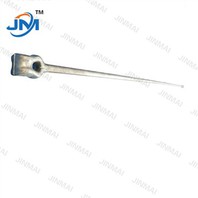
In the world of cable components, pigtail hook bolts are indispensable hardware items widely used in various applications, including cable installation, wiring, and suspension systems. As a professional supplier of Pigtail Hook Bolts, I am often asked about the standard length of these bolts. In this blog post, I will delve into this topic to provide you with a comprehensive understanding.
General Overview of Pigtail Hook Bolts
Pigtail hook bolts are a type of fastener with a unique design. They typically feature a threaded rod with a hook at one end, which can be used to hang or secure cables, wires, or other components. The hook allows for easy attachment and removal, while the threaded part enables a secure connection to a nut or a pre - threaded hole. Pigtail Hook Bolts come in different sizes, materials, and finishes to suit diverse environmental and application requirements.
Factors Influencing the Length of Pigtail Hook Bolts
The determination of the standard length of pigtail hook bolts is not an arbitrary process. It is influenced by several factors that must be carefully considered to ensure proper functionality and safety.


1. Application Requirements
The intended use of the pigtail hook bolt is one of the primary factors affecting its length. For example, in a simple household cable setup, the length might be relatively short, perhaps just a few centimeters, as it only needs to secure a small number of cables in a confined space. On the other hand, in large - scale industrial cable installations, such as those in power plants or telecommunications facilities, longer bolts may be required. These bolts need to span greater distances and hold multiple cables securely.
In cable suspension systems on transmission poles, the length of the pigtail hook bolt is chosen based on the number of cables to be supported and the spacing between the attachment points. A longer bolt can accommodate more cables or provide a wider separation between cables, which is important for preventing interference and ensuring proper cable management.
2. Structural Considerations
The structure where the pigtail hook bolt is to be installed also plays a crucial role. If the bolt is used in a thick - walled structure, such as a heavy - duty steel frame, a longer bolt may be needed to penetrate the material and provide a sufficient thread engagement for a secure hold. Conversely, in a thin - walled structure, a shorter bolt would be appropriate to avoid protruding through the opposite side and causing safety hazards or aesthetic issues.
For instance, when installing pigtail hook bolts on a wooden cable tray, the length should be carefully selected to ensure that the bolt does not split the wood. A bolt that is too long may cause the wood to crack under the pressure of tightening, while a bolt that is too short may not provide enough holding force.
3. Safety Margins
Safety is of utmost importance in any engineering and installation project. When determining the length of pigtail hook bolts, appropriate safety margins must be considered. A longer bolt with some extra length beyond the necessary connection can provide additional stability and reduce the risk of the bolt loosening or coming out over time due to vibrations or external forces.
Manufacturers often recommend a minimum and maximum length range for different applications to ensure that these safety margins are met. For example, in a high - vibration environment, such as a machinery room, a longer bolt with a larger thread engagement can better resist the loosening effect of the vibrations.
Standard Lengths in the Market
While there is no one - size - fits - all standard length for pigtail hook bolts due to the various influencing factors mentioned above, there are some common lengths available in the market that are widely used.
Short - Length Pigtail Hook Bolts
Short - length pigtail hook bolts, typically ranging from 25mm to 50mm, are commonly used in small - scale applications. These are suitable for light - duty cable installations, such as in home electronics or small - scale workshop projects. They are also useful for applications where the available space is limited, such as in compact cable racks or enclosures.
Medium - Length Pigtail Hook Bolts
The medium - length range, usually from 50mm to 150mm, is the most versatile and widely used. These bolts are suitable for a variety of general - purpose cable installation and suspension applications. They can be used in both commercial and industrial settings, such as office buildings, factories, and data centers. The medium length provides a good balance between the ability to hold cables securely and the flexibility to fit in different installation scenarios.
Long - Length Pigtail Hook Bolts
Long - length pigtail hook bolts, with lengths exceeding 150mm, are used in specialized applications where greater reach or the need to support a large number of cables is required. For example, in outdoor cable installations along power transmission lines or large - scale communication networks, long bolts are necessary to span long distances and hold multiple heavy - gauge cables in place.
Relationship with Other Cable Components
Pigtail hook bolts are often used in conjunction with other cable components, such as Cable Pole Hook and Pig tail ball head. The length of the pigtail hook bolt can also impact its compatibility with these components.
For example, when used with a cable pole hook, the length of the pigtail hook bolt should be such that it can properly engage with both the hook and the cable or other attachment points. If the bolt is too short, it may not be able to provide a secure connection, while if it is too long, it may interfere with the normal operation of the cable pole hook.
Similarly, when used with a pig tail ball head, the length needs to be coordinated to ensure seamless integration. The correct length allows for easy installation and adjustment of the overall cable system.
Importance of Choosing the Right Length
Selecting the appropriate length of pigtail hook bolts is crucial for the overall performance and safety of the cable installation. An incorrect length can lead to a variety of problems.
If the bolt is too short, it may not provide enough thread engagement, resulting in a weak connection. This can cause the cable to become loose over time, leading to potential safety hazards, such as electrical short - circuits in the case of electrical cables or cable disconnection in a mechanical suspension system.
On the other hand, if the bolt is too long, it can cause difficulty in installation, as it may protrude through the mounting surface and interfere with other components. It can also increase the risk of damage to the surrounding structure or other cables due to unnecessary contact.
Conclusion and Call to Action
In conclusion, the standard length of pigtail hook bolts varies depending on multiple factors, including application requirements, structural considerations, and safety margins. There are common length ranges in the market, but the specific length should be carefully selected based on the actual situation.
As a reliable supplier of Pigtail Hook Bolts, I am dedicated to providing high - quality products in various lengths to meet your diverse needs. Whether you are working on a small - scale home project or a large - scale industrial installation, we have the right pigtail hook bolts for you.
If you are interested in purchasing pigtail hook bolts or need further advice on choosing the appropriate length for your application, please feel free to contact us for procurement discussions. We have a team of experts who can offer you professional guidance and support.
References
- ASTM International standards related to fasteners.
- Industry handbooks on cable installation and hardware.