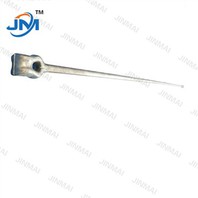
What is the thread pitch of pigtail hook bolts?
As a supplier of Pigtail Hook Bolts, I often receive inquiries from customers about various technical aspects of these products. One of the frequently asked questions is about the thread pitch of pigtail hook bolts. In this blog post, I will delve into the concept of thread pitch, its significance in pigtail hook bolts, and how it impacts the performance and application of these essential hardware components.
Understanding Thread Pitch
Thread pitch is a fundamental characteristic of threaded fasteners, including pigtail hook bolts. It refers to the distance between adjacent threads on a bolt. Measured in millimeters for metric bolts and threads per inch (TPI) for imperial bolts, thread pitch determines how tightly the bolt will engage with a corresponding nut or threaded hole.
For example, in a metric system, a bolt with a thread pitch of 1.5 mm means that the distance between two consecutive threads is 1.5 mm. In the imperial system, a bolt with 20 TPI has 20 threads in one inch of its length.
Importance of Thread Pitch in Pigtail Hook Bolts
The thread pitch of pigtail hook bolts plays a crucial role in several aspects of their functionality:
1. Fit and Compatibility
The correct thread pitch ensures that the pigtail hook bolt can be properly installed with the corresponding nut or threaded component. If the thread pitch does not match, the bolt may not screw in smoothly, or it may not hold securely, leading to a loose connection. This can be particularly dangerous in applications where the pigtail hook bolt is used to support heavy loads or where vibration is present.


2. Load - Bearing Capacity
The thread pitch affects the load - bearing capacity of the pigtail hook bolt. A finer thread pitch (more threads per unit length) generally provides a greater surface area of contact between the bolt and the nut or threaded hole. This increased contact area distributes the load more evenly, allowing the bolt to withstand higher loads without stripping the threads.
3. Ease of Installation
The choice of thread pitch can also influence the ease of installation. Coarse threads are generally easier to start and can be tightened more quickly, making them suitable for applications where rapid installation is required. On the other hand, fine threads require more turns to achieve the same amount of advancement, but they offer better precision and are less likely to loosen under vibration.
Common Thread Pitches for Pigtail Hook Bolts
Pigtail hook bolts are available in a variety of thread pitches to meet different application requirements.
Metric Thread Pitches
In the metric system, common thread pitches for pigtail hook bolts range from coarse pitches such as M6 x 1.0, M8 x 1.25, and M10 x 1.5 to finer pitches like M6 x 0.75, M8 x 1.0, and M10 x 1.25. The coarser pitches are often used in general - purpose applications where speed of installation and high - load capacity are important. The finer pitches are preferred in applications where precise adjustment and resistance to vibration are required.
Imperial Thread Pitches
For imperial pigtail hook bolts, common thread pitches include 8 TPI, 10 TPI, 12 TPI, and 20 TPI. The 8 TPI is a relatively coarse pitch, suitable for heavy - duty applications, while the 20 TPI is a fine pitch used in applications where fine adjustment and a more secure connection are needed.
Factors Affecting the Choice of Thread Pitch
When selecting the thread pitch for pigtail hook bolts, several factors need to be considered:
1. Application Requirements
The nature of the application is the primary factor in determining the appropriate thread pitch. For example, in a construction project where pigtail hook bolts are used to secure heavy cables to poles, a coarse thread pitch may be preferred for its high - load capacity and ease of installation. In contrast, in a precision engineering application such as the assembly of electronic equipment, a fine thread pitch may be necessary for accurate alignment and a secure connection.
2. Material of the Components
The material of the pigtail hook bolt and the mating component also affects the choice of thread pitch. Softer materials may require a coarser thread pitch to prevent the threads from stripping during installation or under load. Harder materials can accommodate finer thread pitches, which can provide better performance in terms of load - distribution and resistance to loosening.
3. Environmental Conditions
Environmental factors such as vibration, temperature, and corrosion can also influence the selection of thread pitch. In a high - vibration environment, a fine thread pitch may be more suitable as it is less likely to loosen over time. In a corrosive environment, the choice of thread pitch may be combined with appropriate surface treatments to ensure the long - term integrity of the connection.
Related Products and Their Thread Pitch Considerations
In addition to Pigtail Hook Bolts, our product range also includes Pig tail ball head and Hardware Pole Line Hook. Similar to pigtail hook bolts, the thread pitch of these products is a critical factor in their performance.
For Pig tail ball head, the thread pitch needs to be carefully selected to ensure a proper connection with the corresponding components. A correct thread pitch allows for easy installation and a secure fit, which is essential for the reliable operation of the ball - head assembly.
Hardware Pole Line Hook often needs to support heavy cables and withstand various environmental conditions. The thread pitch of these hooks should be chosen based on the load - bearing requirements and the installation environment. A coarse thread pitch may be suitable for quick installation and high - load applications, while a fine thread pitch can provide better resistance to loosening in a vibrating environment.
Conclusion
The thread pitch of pigtail hook bolts is a vital characteristic that affects their fit, load - bearing capacity, ease of installation, and overall performance. As a supplier, we understand the importance of providing the right thread pitch for different applications. By considering factors such as application requirements, material of the components, and environmental conditions, we can help our customers select the most suitable pigtail hook bolts and related products.
If you are in need of high - quality pigtail hook bolts, Pig tail ball head, or Hardware Pole Line Hook, and have questions about thread pitch or other technical aspects, please feel free to contact us. We are here to provide you with professional advice and the best products to meet your needs. Let's start a discussion about your specific requirements and find the perfect solution together.
References
- Machinery's Handbook, 31st Edition, Industrial Press Inc.
- Fastener Standards and Specifications, American Society of Mechanical Engineers (ASME)