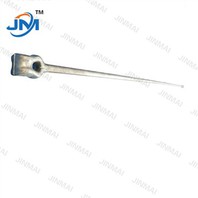
Hey there! As a supplier of insulator spindles, I often get asked whether these nifty little devices are suitable for use in low - temperature environments. It's a great question, and one that I'm more than happy to dig into with you.
First off, let's talk about what insulator spindles are. These are essential components in electrical systems. They're used to support and insulate electrical conductors, making sure that the electricity flows where it's supposed to and doesn't cause any unwanted issues. There are different types, like the Pin Insulator Spindle, the Steel Pin of Pin Insulator, and the Crossarm Long Shank Spindle. Each type has its own unique features and applications, but they all share the common goal of keeping electrical systems running smoothly.
Now, let's get to the main point - low - temperature environments. When it comes to cold weather, a lot of things can happen to materials. For insulator spindles, the biggest concerns are related to the materials they're made of and how they react to the cold.
Most insulator spindles are made from materials like porcelain, glass, or composite polymers. Porcelain is a popular choice because it's strong, durable, and has good electrical insulation properties. In low - temperature environments, porcelain can handle the cold pretty well. It has a relatively low coefficient of thermal expansion, which means that it doesn't expand or contract too much when the temperature changes. This is important because if a material expands or contracts too much, it can crack or break, which would obviously be a big problem for an insulator spindle.
Glass is another option. Glass insulators are known for their high dielectric strength, which means they can withstand high voltages without breaking down. Like porcelain, glass also has a relatively low coefficient of thermal expansion. However, glass is more brittle than porcelain. In extremely cold conditions, there's a higher risk of it cracking if it experiences any sudden impacts or temperature changes. So, while glass can work in low - temperature environments, you need to be a bit more careful with it.
Composite polymers are becoming more and more popular for insulator spindles. These materials are lightweight, easy to install, and can be designed to have specific properties. In low - temperature environments, composite polymers can be formulated to have good cold - weather performance. However, not all composite polymers are created equal. Some may become stiff and lose their flexibility in the cold, which could affect their ability to absorb vibrations and shocks. So, it's important to choose a composite polymer that's specifically designed for low - temperature use.
Another factor to consider is the presence of ice and snow. In cold climates, ice and snow can accumulate on the insulator spindles. This can increase the weight on the spindles, which could potentially cause them to break or bend. Ice can also create a conductive path on the surface of the insulator, which can lead to electrical arcing and other problems. To combat this, some insulator spindles are designed with special shapes or coatings to prevent ice and snow from sticking.
Let's talk about the performance of insulator spindles in low - temperature environments from an electrical perspective. Cold temperatures can affect the electrical properties of the materials. For example, the dielectric constant of some materials may change slightly in the cold. This could potentially affect the way the insulator spindle distributes the electrical field around it. However, in most cases, these changes are small and don't have a significant impact on the overall performance of the electrical system.


Now, let's look at some real - world examples. In places like Canada, Russia, and Scandinavia, where the winters can be extremely cold, insulator spindles are used extensively in electrical power transmission and distribution systems. These systems have been designed to withstand the cold, and the insulator spindles play a crucial role in their operation. In these regions, the choice of insulator spindles is carefully considered, taking into account the specific low - temperature conditions.
So, are insulator spindles suitable for use in low - temperature environments? The answer is yes, but with some caveats. It depends on the type of material, the design of the spindle, and the specific cold - weather conditions. If you choose the right type of insulator spindle and take the necessary precautions, they can work very well in low - temperature environments.
If you're in the market for insulator spindles and you're dealing with low - temperature conditions, I'd be more than happy to help you make the right choice. We have a wide range of insulator spindles, including the Pin Insulator Spindle, the Steel Pin of Pin Insulator, and the Crossarm Long Shank Spindle. Our team of experts can provide you with all the information you need to ensure that you get the best insulator spindles for your specific application.
Whether you're building a new electrical system or upgrading an existing one in a cold - weather area, don't hesitate to reach out. We're here to help you find the perfect insulator spindles that will perform well in low - temperature environments and keep your electrical system running smoothly.
In conclusion, insulator spindles can be a great choice for low - temperature environments as long as you understand the materials, design, and potential challenges. With the right selection and proper installation, you can have reliable insulator spindles that will stand up to the cold.
References:
- Electrical Insulation Handbook, various authors
- Journal of Electrical Engineering and Technology, multiple issues related to insulator performance in different environments