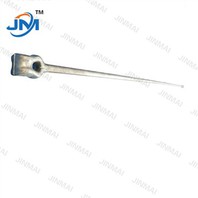
As a long - time supplier of insulator spindles, I've received numerous inquiries regarding the feasibility of using insulator spindles in high - frequency applications. This topic is of great significance, as high - frequency applications are becoming increasingly prevalent in modern industries, such as telecommunications, radio frequency (RF) technology, and power electronics. In this blog, I will delve into the technical aspects of insulator spindles and analyze whether they can be effectively utilized in high - frequency scenarios.
Understanding Insulator Spindles
Insulator spindles are essential components in electrical systems. They are designed to support and insulate electrical conductors, preventing the flow of current to unwanted areas. These spindles are typically made from materials with high dielectric strength, such as ceramic, glass, or certain types of polymers. The choice of material depends on various factors, including the operating voltage, environmental conditions, and mechanical requirements.
For instance, ceramic insulator spindles are known for their excellent mechanical strength, high temperature resistance, and good electrical insulation properties. Glass insulator spindles, on the other hand, offer high transparency, which can be advantageous in some applications where visual inspection is required. Polymer - based insulator spindles are lightweight and have good flexibility, making them suitable for applications where mechanical stress is a concern.
We offer a wide range of insulator spindles, including Pin Insulator Spindle, Pole Top Pins Spindle, and Crossarm Long Shank Spindle. Each type is designed to meet specific application needs, whether it's for overhead power lines, distribution transformers, or other electrical equipment.
High - Frequency Considerations
When it comes to high - frequency applications, several factors need to be taken into account. One of the primary concerns is the dielectric loss of the insulator material. At high frequencies, the dielectric material in the insulator spindle can absorb electrical energy and convert it into heat. This phenomenon, known as dielectric loss, can lead to increased temperature rise in the insulator, which may affect its performance and lifespan.
The dielectric constant of the material also plays a crucial role. In high - frequency applications, a stable dielectric constant is required to ensure consistent electrical performance. A material with a high and unstable dielectric constant can cause signal distortion and attenuation, which is unacceptable in many high - frequency systems.
Another important factor is the skin effect. At high frequencies, the current tends to flow near the surface of the conductor. This means that the electrical properties of the outer layer of the insulator spindle become more critical. If the insulator material has poor surface conductivity or high surface resistance, it can cause additional losses and affect the overall performance of the system.
Can Insulator Spindles Be Used in High - Frequency Applications?
The answer is both yes and no. It depends on the specific requirements of the high - frequency application and the properties of the insulator spindle.
In some low - power high - frequency applications, where the dielectric loss and signal distortion requirements are not extremely strict, certain types of insulator spindles can be used. For example, polymer - based insulator spindles with low dielectric loss and stable dielectric constants can be suitable for some radio frequency (RF) circuits operating at relatively low frequencies.
However, in high - power high - frequency applications, such as high - power RF amplifiers or microwave systems, the requirements for insulator spindles are much more stringent. In these cases, traditional insulator spindles may not be sufficient. Specialized materials and designs are often required to minimize dielectric loss, maintain a stable dielectric constant, and reduce the skin effect.
For example, in some high - power microwave applications, single - crystal sapphire or other advanced ceramic materials may be used as insulator spindles. These materials have extremely low dielectric loss and high thermal conductivity, which can effectively dissipate the heat generated by the dielectric loss.
Our Solutions for High - Frequency Applications
As an insulator spindle supplier, we are constantly researching and developing new materials and designs to meet the evolving needs of high - frequency applications. We work closely with our customers to understand their specific requirements and provide customized solutions.
We offer a series of high - performance insulator spindles that are designed to minimize dielectric loss and maintain a stable dielectric constant at high frequencies. Our R & D team is continuously exploring new materials and manufacturing processes to improve the performance of our products.
For example, we have developed a new type of ceramic insulator spindle with a unique microstructure that reduces the dielectric loss at high frequencies. This product has been successfully tested in some high - frequency power electronics applications and has received positive feedback from our customers.
Conclusion
In conclusion, while the use of insulator spindles in high - frequency applications is possible, it requires careful consideration of various factors, including dielectric loss, dielectric constant, and the skin effect. Our company, as a professional insulator spindle supplier, is committed to providing high - quality products and customized solutions for high - frequency applications.
If you are interested in our insulator spindles or have specific requirements for high - frequency applications, we welcome you to contact us for procurement and further discussions. Our team of experts is ready to assist you in finding the most suitable insulator spindle solutions for your needs.


References
- Grover, F. W. (1946). Inductance Calculations: Working Formulas and Tables. Dover Publications.
- Paul, C. R. (2008). Analysis of Multiconductor Transmission Lines. John Wiley & Sons.
- Ramo, S., Whinnery, J. R., & Van Duzer, T. (1994). Fields and Waves in Communication Electronics. John Wiley & Sons.