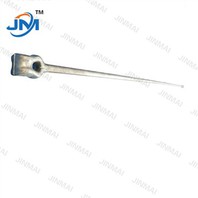
As a seasoned supplier of Galvanized Cross Arms, I understand the critical importance of ensuring the strength and reliability of our products. Galvanized cross arms play a pivotal role in overhead power distribution and communication systems, supporting cables and wires that carry essential services. Therefore, rigorous testing of their strength is not just a quality control measure but a necessity for the safety and efficiency of these systems.
Understanding the Basics of Galvanized Cross Arms
Before delving into the testing methods, it's essential to understand what galvanized cross arms are and why they are used. Galvanized cross arms are typically made of steel that has been coated with a layer of zinc through a galvanization process. This zinc coating provides excellent corrosion resistance, extending the lifespan of the cross arms, especially in harsh environmental conditions. They are used in overhead power lines, telecommunication networks, and other applications where cables need to be supported at a certain height.
Importance of Strength Testing
The strength of a galvanized cross arm is crucial for several reasons. Firstly, it must be able to support the weight of the cables and any additional loads, such as ice or wind forces. A weak cross arm can lead to cable sagging, which may cause short - circuits, service disruptions, or even pose a safety hazard to people and property below. Secondly, in areas prone to extreme weather conditions, such as hurricanes or heavy snowstorms, the cross arms need to withstand significant stress without failing. Therefore, accurate strength testing ensures that our products meet the required standards and can perform reliably in real - world scenarios.


Visual Inspection
The first step in testing the strength of a galvanized cross arm is a thorough visual inspection. This may seem like a simple step, but it can reveal a lot about the integrity of the product. We check for any visible signs of damage, such as cracks, dents, or surface irregularities. Cracks can significantly weaken the cross arm and may propagate under stress, leading to failure. Dents can also affect the structural integrity, especially if they are located in critical load - bearing areas. Surface irregularities, such as uneven galvanization, may indicate potential corrosion problems in the future, which can also compromise the strength of the cross arm.
Material Testing
Material testing is a fundamental part of assessing the strength of a galvanized cross arm. We start by analyzing the chemical composition of the steel used in the cross arm. The correct chemical composition is essential for achieving the desired mechanical properties. For example, the carbon content affects the hardness and strength of the steel. Too much carbon can make the steel brittle, while too little can result in low strength.
We also conduct tensile tests on samples of the steel. In a tensile test, a sample is subjected to a gradually increasing pulling force until it breaks. The test measures the ultimate tensile strength, yield strength, and elongation of the steel. The ultimate tensile strength is the maximum stress the steel can withstand before breaking, while the yield strength is the stress at which the steel begins to deform permanently. Elongation indicates the ductility of the steel, which is important as it allows the cross arm to absorb some energy before failure.
Structural Testing
In addition to material testing, we perform structural testing on the entire galvanized cross arm. One of the most common methods is the static load test. In a static load test, the cross arm is mounted in a test fixture that simulates its real - world installation. We then apply a known load to the cross arm, typically at the points where the cables will be attached. The load is gradually increased until the cross arm reaches its maximum capacity or shows signs of failure.
During the test, we use strain gauges to measure the deformation of the cross arm. Strain gauges are small sensors that can detect even the slightest changes in the dimensions of the cross arm. By analyzing the strain data, we can determine how the cross arm is responding to the load and identify any areas of high stress. This information helps us to evaluate the overall strength of the cross arm and ensure that it meets the design requirements.
Another important structural test is the fatigue test. In real - world applications, galvanized cross arms are subjected to repeated loading and unloading cycles due to factors such as wind, vibration, and temperature changes. A fatigue test simulates these cyclic loads to determine how the cross arm will perform over its expected service life. The cross arm is subjected to a series of alternating loads at a specific frequency, and the number of cycles it can withstand before failure is recorded. This test helps us to ensure that our cross arms have sufficient fatigue resistance and can last for many years without failing.
Compliance with Standards
Our testing procedures are designed to ensure that our Galvanized Cross Arms comply with national and international standards. For example, in the United States, the cross arms must meet the standards set by the American National Standards Institute (ANSI) and the Institute of Electrical and Electronics Engineers (IEEE). These standards specify the minimum strength requirements, material properties, and testing methods for overhead line hardware.
By adhering to these standards, we can guarantee that our products are of high quality and can be used safely in a wide range of applications. We also regularly update our testing procedures to keep up with the latest industry standards and technological advancements.
Conclusion
Testing the strength of a galvanized cross arm is a comprehensive process that involves visual inspection, material testing, and structural testing. As a supplier, we are committed to providing our customers with high - quality products that meet or exceed industry standards. Our rigorous testing procedures ensure that our Galvanized Cross Arms are strong, reliable, and can withstand the challenges of real - world applications.
If you are in the market for Cable Accessories Iron Cross Arm, Galvanized Cross Arm, or Overhead Pole Line Hardware, we invite you to contact us for more information. Our team of experts is ready to assist you with your specific requirements and provide you with the best solutions for your overhead line projects. Whether you need a small quantity for a local installation or a large - scale supply for a major infrastructure project, we can meet your needs.
References
- American National Standards Institute (ANSI) standards related to overhead line hardware.
- Institute of Electrical and Electronics Engineers (IEEE) standards for electrical power distribution.
- Textbooks on materials science and engineering for steel properties and testing methods.