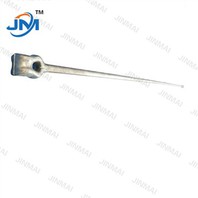
Hey there! As a supplier of overhead line fittings, I often get asked about how to calculate the quantity of these fittings needed for a project. It's not as straightforward as it might seem at first glance, but with a bit of know - how, you can get a pretty accurate estimate.
First off, let's understand what overhead line fittings are. These are the components used to support, secure, and protect overhead power lines. They include things like insulators, connectors, and hardware for poles. Different projects have different requirements based on factors such as the length of the line, the type of power being transmitted, and the local environmental conditions.
1. Determine the Project Scope
The very first step is to figure out the scope of your project. You need to know the length of the overhead line. Measure the distance from the starting point to the ending point of the line. If it's a complex network with multiple branches, break it down into smaller sections and measure each one separately.
For example, if you're working on a rural electrification project that spans across several kilometers, you'll need to get a detailed map and measure the exact length of each line segment. This information is crucial because many of the fittings are required at regular intervals along the line.
2. Consider the Line Configuration
The configuration of the overhead line plays a huge role in determining the quantity of fittings. There are different types of line configurations, such as single - phase, three - phase, and multi - circuit lines.
A single - phase line is simpler and usually requires fewer fittings compared to a three - phase line. A three - phase line, which is commonly used for high - power transmission, needs more insulators, connectors, and other support hardware. For instance, in a three - phase line, you'll need three sets of insulators for each pole, while a single - phase line might only need one or two.
Multi - circuit lines, where multiple lines are run on the same set of poles, are even more complex. You have to account for the additional space between the circuits and the extra fittings needed to separate and support them.
3. Calculate the Number of Poles
Poles are the backbone of any overhead line system. The number of poles you need depends on the length of the line and the recommended pole spacing. Pole spacing is determined by factors like the type of terrain, the weight of the conductors, and the wind and ice loads in the area.
In flat and open areas, pole spacing can be relatively large, maybe around 50 - 100 meters. But in hilly or forested areas, the spacing might be reduced to 30 - 50 meters. To calculate the number of poles, divide the total length of the line by the pole spacing and then add one (to account for the starting pole).
For example, if you have a 1000 - meter line with a pole spacing of 50 meters, the number of poles would be (1000 / 50)+1 = 21 poles.
4. Fittings per Pole
Once you know the number of poles, you need to figure out how many fittings are required for each pole. Different types of poles (wooden, concrete, or steel) might have different fitting requirements.


- Insulators: Insulators are used to keep the conductors away from the poles and prevent electrical leakage. The number of insulators per pole depends on the line configuration. As mentioned earlier, a three - phase line will need more insulators than a single - phase line. For a standard three - phase line, you might need three or more insulators per pole.
- Connectors: Connectors are used to join the conductors together. You'll need one or more connectors at each pole, depending on how the conductors are arranged. For example, if you have a tap - off from the main line at a pole, you'll need an additional connector.
- Hardware for Pole Support: This includes things like cross - arms and brackets. A Cable Accessories Iron Cross Arm is commonly used to support the insulators and conductors. You'll typically need one or two cross - arms per pole, depending on the line configuration.
5. Account for Special Sections
Some sections of the overhead line might require special fittings. For example, at the end of a line (terminal poles), you'll need special hardware to anchor the conductors and prevent them from pulling away. These terminal poles often require stronger and more specialized fittings compared to intermediate poles.
If the line crosses a road, railway, or a river, you'll need additional fittings to ensure the safety and stability of the line. You might need higher - strength insulators and more robust support structures to withstand the extra stress.
6. Factor in Spares
It's always a good idea to factor in some spare fittings. During the installation process, there's a chance that some fittings might get damaged or lost. Also, having spares on hand can be useful for future maintenance and repairs.
A common rule of thumb is to add around 5 - 10% of the total calculated quantity as spares. So, if you've calculated that you need 100 insulators, it's a good idea to order 105 - 110 insulators.
7. Use Standard Industry Guidelines
There are standard industry guidelines and codes that can help you in calculating the quantity of overhead line fittings. These guidelines are based on years of experience and research in the field of electrical engineering.
For example, the National Electrical Safety Code (NESC) provides detailed recommendations on things like pole spacing, insulator strength, and fitting requirements. Make sure to consult these guidelines and follow them to ensure the safety and reliability of your overhead line project.
8. Consult with Experts
If you're still unsure about how to calculate the quantity of fittings, don't hesitate to consult with experts in the field. As an overhead line fitting supplier, I've helped many customers with their projects. I can offer valuable insights based on my experience with different types of projects.
You can also reach out to electrical engineers or contractors who have worked on similar projects. They can share their knowledge and help you avoid common mistakes.
Let's Talk!
Calculating the quantity of overhead line fittings for a project is a complex but manageable task. By following the steps outlined above, you can get a good estimate of the fittings you'll need. And if you're in the market for high - quality overhead line fittings, I'm here to help. Whether you need Hot Dip Galvanized Secondary Clevis, Cable Accessories Iron Cross Arm, or Overhead Pole Line Hardware, I've got you covered.
If you have any questions or want to discuss your project in more detail, feel free to get in touch. I'm always happy to assist you in finding the right fittings for your needs and ensuring the success of your overhead line project.
References
- National Electrical Safety Code (NESC)
- Electrical Power Transmission System Engineering: Analysis and Design by Turan Gonen