How to ensure the dimensional accuracy of overhead line fittings?
As a seasoned supplier of overhead line fittings, I understand the critical role that dimensional accuracy plays in the performance and reliability of electrical transmission and distribution systems. Overhead line fittings are essential components that connect, support, and protect power lines, and any deviation from the specified dimensions can lead to serious issues such as poor electrical conductivity, mechanical failure, and safety hazards. In this blog post, I will share some key strategies and best practices that we employ to ensure the dimensional accuracy of our overhead line fittings.
1. Precise Design and Engineering
The journey towards dimensional accuracy begins with precise design and engineering. Our team of experienced engineers uses advanced computer-aided design (CAD) software to create detailed 3D models of each fitting. These models are carefully analyzed to ensure that all dimensions are within the required tolerances and that the fitting will function as intended in the real-world environment.
During the design phase, we also consider the specific requirements of the project, such as the type of power line, the environmental conditions, and the installation method. This allows us to optimize the design of the fitting to meet the unique needs of each customer. For example, if the fitting will be installed in a high-wind area, we may increase the thickness of the material or add additional reinforcement to ensure its structural integrity.
2. High - Quality Raw Materials
The quality of the raw materials used in manufacturing overhead line fittings has a direct impact on their dimensional accuracy. We source our raw materials from trusted suppliers who adhere to strict quality control standards. For example, when manufacturing Galvanized Cross Arm, we use high - grade steel that has been tested for its chemical composition and mechanical properties.
The raw materials are also inspected upon arrival at our factory to ensure that they meet our specifications. Any materials that do not meet the required standards are rejected, and only the highest - quality materials are used in the production process. This helps to minimize the risk of dimensional variations caused by substandard materials.
3. Advanced Manufacturing Processes
We utilize state - of - the - art manufacturing processes to produce overhead line fittings with high dimensional accuracy. Our manufacturing facilities are equipped with modern machinery, such as CNC machining centers, laser cutting machines, and automated welding equipment.
CNC machining centers are programmed to precisely cut and shape the raw materials according to the design specifications. This allows us to achieve tight tolerances and consistent dimensions across multiple parts. Laser cutting machines provide clean and accurate cuts, which are essential for ensuring the proper fit and function of the fittings. Automated welding equipment ensures that the welds are strong and uniform, which helps to maintain the structural integrity of the fittings and their dimensional stability.
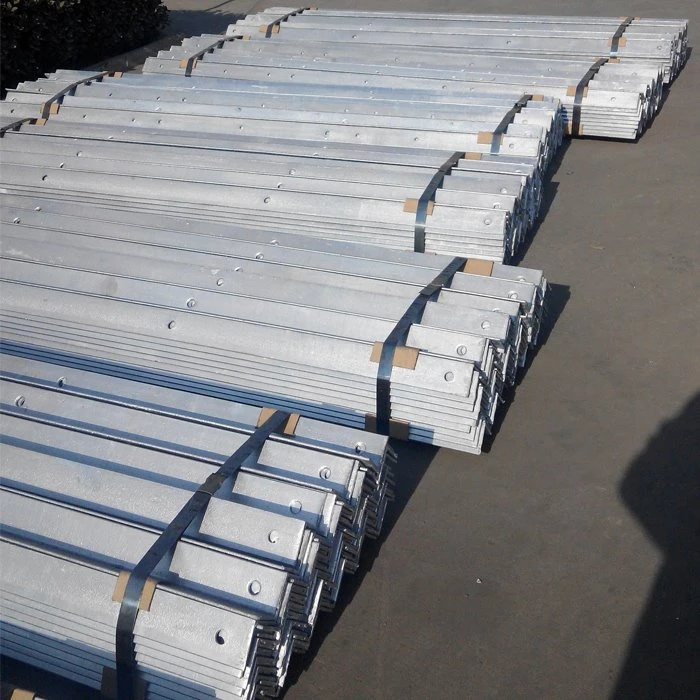
For instance, when manufacturing Steel Angle Cross Arm, we use CNC bending machines to bend the steel angles to the exact angles and radii specified in the design. This ensures that the cross arms fit perfectly on the poles and support the power lines as intended.
4. Rigorous Quality Control Checks
Quality control is an integral part of our manufacturing process. We have implemented a comprehensive quality control system that includes multiple inspection points at every stage of production.

Raw materials are inspected for their dimensions, surface finish, and chemical composition before they are used in manufacturing. During the manufacturing process, in - process inspections are carried out to ensure that the parts are being produced within the specified tolerances. This includes checking the dimensions of machined parts, the quality of welds, and the surface finish of the fittings.
Final inspections are conducted before the fittings are packaged and shipped to the customer. These inspections include a thorough check of all dimensions, as well as functional tests to ensure that the fittings perform as expected. We use a variety of measuring tools, such as calipers, micrometers, and coordinate measuring machines (CMMs), to ensure the accuracy of our measurements.
5. Skilled Workforce
Our skilled workforce is another key factor in ensuring the dimensional accuracy of our overhead line fittings. Our employees undergo regular training to keep up with the latest manufacturing techniques and quality control standards. They are also encouraged to take pride in their work and to pay attention to detail.
Our operators are responsible for setting up and operating the manufacturing equipment, and they are trained to make adjustments as needed to ensure that the parts are produced within the specified tolerances. Our quality control inspectors are highly trained professionals who are able to identify and address any dimensional issues that may arise during the production process.
6. Continuous Improvement
We believe in continuous improvement, and we are constantly looking for ways to enhance the dimensional accuracy of our overhead line fittings. We collect and analyze data from our production processes and quality control inspections to identify areas for improvement.
Based on this data, we make changes to our manufacturing processes, equipment, and quality control procedures to reduce dimensional variations and improve the overall quality of our products. For example, if we notice that a particular type of fitting has a higher rate of dimensional non - conformities, we may invest in new equipment or modify our manufacturing process to address the issue.
In addition, we also stay up - to - date with the latest industry trends and technological advancements. We participate in industry conferences and collaborate with research institutions to learn about new materials, manufacturing processes, and quality control methods that can help us to improve the dimensional accuracy of our products.
Conclusion
Ensuring the dimensional accuracy of overhead line fittings is crucial for the safe and reliable operation of electrical transmission and distribution systems. By implementing precise design and engineering, using high - quality raw materials, employing advanced manufacturing processes, conducting rigorous quality control checks, relying on a skilled workforce, and continuously improving our processes, we are able to produce overhead line fittings that meet the highest standards of dimensional accuracy.
If you are in the market for high - quality Overhead Pole Line Hardware or other overhead line fittings, we invite you to contact us for more information. Our team of experts is ready to assist you in finding the right products for your project and to answer any questions you may have. We look forward to the opportunity to work with you and to provide you with the best - in - class overhead line fittings.
References
- "Electrical Transmission and Distribution Handbook", Third Edition, by Turan Gonen.
- "Power System Engineering", Second Edition, by C. L. Wadhwa.
- Industry standards and specifications related to overhead line fittings, such as IEEE and IEC standards.