Hey there! I'm a supplier of metal stamping parts, and today I wanna chat about the thermal expansion requirements for these parts in temperature - changing environments. It's a topic that's super important, yet often overlooked in the industry.
Let's start with the basics. Thermal expansion is a natural phenomenon where materials expand or contract when they're exposed to temperature changes. Metals, in particular, are quite sensitive to these changes. When the temperature rises, the atoms in the metal start vibrating more vigorously, causing the metal to expand. Conversely, when the temperature drops, the metal contracts.

Now, why does this matter for metal stamping parts? Well, think about it. These parts are used in all sorts of applications, from small electronic devices to large industrial machinery. In temperature - changing environments, if the thermal expansion of the metal stamping parts isn't properly accounted for, it can lead to a whole bunch of problems.
For instance, in precision machinery, even a tiny amount of expansion or contraction can throw off the alignment of components. This can result in reduced performance, increased wear and tear, and even complete failure of the machinery. In construction, metal stamping parts like Pole Clamps Are Used On Utility Poles need to maintain their structural integrity in different weather conditions. If they expand too much in hot weather or contract too much in cold weather, they might not hold the poles securely, posing a safety risk.
So, what are the thermal expansion requirements for metal stamping parts? First off, we need to consider the coefficient of thermal expansion (CTE) of the metal. Different metals have different CTEs. For example, aluminum has a relatively high CTE, which means it expands and contracts more than some other metals like steel. When choosing the metal for stamping parts, we have to pick one that has a CTE suitable for the expected temperature range of the application.
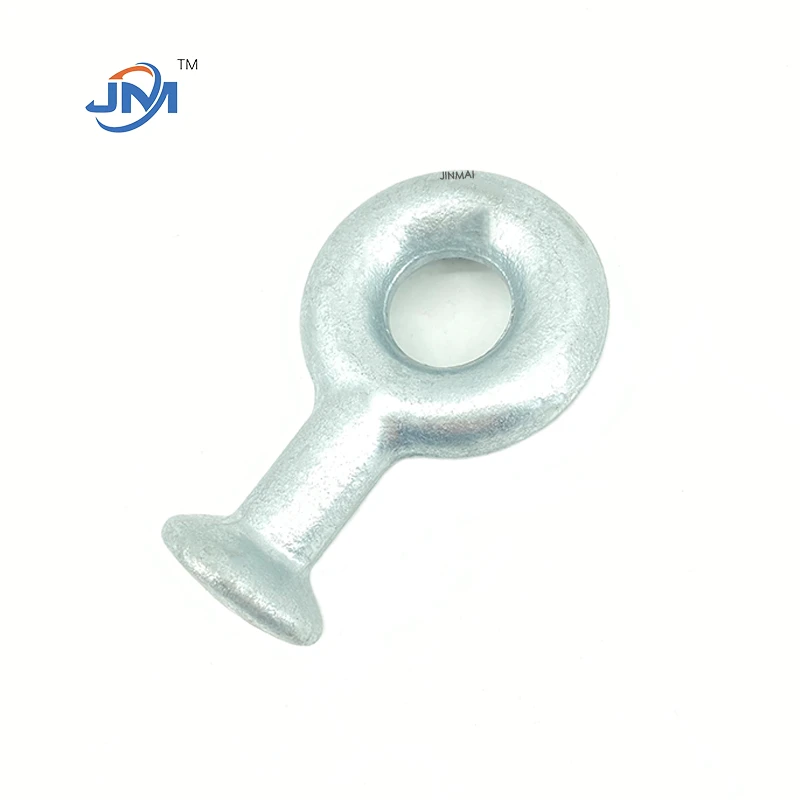
Another important requirement is dimensional stability. Metal stamping parts should be designed in such a way that they can accommodate the expected thermal expansion without losing their functionality. This might involve leaving some clearance between parts, or using flexible connections. For example, Hot - DIP Galvanized Link - Fittings Ball Eye used in some structures need to be able to move slightly to account for thermal expansion, while still maintaining their connection and strength.
We also need to pay attention to the manufacturing process. The way the metal is stamped can affect its thermal expansion properties. For example, if the stamping process creates internal stresses in the metal, these stresses can cause uneven expansion and contraction. So, we use techniques like annealing to relieve these stresses and ensure more uniform thermal behavior.
In addition, surface treatments can play a role. Some coatings can help protect the metal from the effects of temperature changes. They can act as a barrier, reducing the rate of heat transfer and minimizing the amount of expansion or contraction. However, we have to make sure that the coating itself doesn't interfere with the normal thermal expansion of the metal.
Let's take a look at a real - world example. Consider Triple Eye Anchor Rod used in large - scale infrastructure projects. These rods are exposed to a wide range of temperatures throughout the year. If the thermal expansion isn't properly managed, they could loosen over time, compromising the stability of the entire structure. That's why we carefully select the metal, design the rods with appropriate tolerances, and apply suitable surface treatments to ensure they can withstand the temperature variations.
As a metal stamping parts supplier, we take these thermal expansion requirements very seriously. We have a team of experts who analyze each project's specific needs. We use advanced simulation tools to predict how the parts will behave under different temperature conditions. This allows us to make informed decisions about the metal selection, design, and manufacturing process.
We also offer customized solutions. Every application is unique, and we understand that one - size - fits - all doesn't work when it comes to thermal expansion requirements. Whether you need parts for a high - temperature industrial furnace or a low - temperature refrigeration unit, we can work with you to develop parts that meet your exact specifications.
If you're in the market for metal stamping parts and are concerned about thermal expansion in temperature - changing environments, don't hesitate to reach out. We're here to help you find the best solutions for your projects. Our goal is to provide you with high - quality parts that perform reliably, no matter what the temperature is.
So, if you're interested in discussing your metal stamping part needs, just drop us a line. We're eager to start a conversation and see how we can assist you in getting the perfect parts for your applications.
References
- "Materials Science and Engineering: An Introduction" by William D. Callister Jr. and David G. Rethwisch
- "Metal Stamping Handbook" by Peter Ulintz