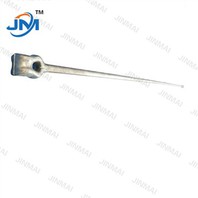
Hey there! As a supplier of Insulator Spindles, I've seen firsthand how these little guys play a crucial role in electrical systems. Today, I wanna chat about something that's super important but often overlooked: the effect of aging on an insulator spindle.
First off, let's quickly go over what an insulator spindle is. It's a key component in electrical setups, used to support and insulate electrical conductors. You can find different types, like the Pole Top Pins Spindle, Voltage Insulator Spindle, and Crossarm Long Shank Spindle. Each type has its own unique job, but they all share the common goal of keeping things safe and running smoothly.
Now, let's dig into how aging affects these insulator spindles. Over time, just like us humans, they start to show some wear and tear. One of the most noticeable effects is on the material properties. Most insulator spindles are made from materials like porcelain or composite polymers.
Porcelain insulators are pretty tough, but they're not immune to aging. As they get older, the porcelain can start to develop small cracks. These cracks might seem insignificant at first, but they can be a big deal. Moisture can seep into these cracks, which can lead to a process called hydrolysis. Hydrolysis breaks down the chemical bonds in the porcelain, weakening its structure. And once the structure is weakened, the insulator's ability to withstand electrical stress goes down the drain. This means there's a higher risk of electrical breakdown, which can cause power outages or even pose a safety hazard.
Composite polymer insulators, on the other hand, have their own set of aging issues. These insulators are made from a combination of polymers and fillers. Over time, exposure to sunlight, heat, and environmental pollutants can cause the polymers to degrade. This degradation can lead to a loss of hydrophobicity, which is the insulator's ability to repel water. When the insulator loses its hydrophobicity, water can form a continuous film on its surface. This film can conduct electricity, increasing the risk of flashovers. Flashovers are sudden electrical discharges that can damage the insulator and disrupt the power supply.
Another aspect affected by aging is the mechanical strength of the insulator spindle. As the material properties change, the spindle becomes less able to withstand mechanical stress. For example, in areas with high winds or heavy ice loads, an aged insulator spindle might not be able to support the weight of the conductors or withstand the forces exerted on it. This can lead to the spindle breaking or bending, which can cause the conductors to come into contact with each other or with other objects, resulting in short circuits.
The electrical performance of the insulator spindle also takes a hit as it ages. The dielectric strength, which is the ability of the insulator to resist electrical breakdown, decreases over time. This means that the insulator can't handle as much voltage as it could when it was new. Additionally, the leakage current, which is the small amount of current that flows through the insulator, tends to increase with age. An increased leakage current can cause heating, which further accelerates the aging process and can eventually lead to complete failure of the insulator.
So, what can be done to deal with the effects of aging on insulator spindles? Regular inspection is crucial. By regularly checking the insulators for signs of cracks, degradation, or other damage, problems can be detected early. If a problem is found, the insulator can be replaced before it causes a major issue.
Proper maintenance is also important. For porcelain insulators, cleaning can help remove dirt and contaminants that can contribute to the aging process. For composite polymer insulators, applying a hydrophobic coating can help restore and maintain their hydrophobicity.


In some cases, it might be necessary to upgrade to newer, more advanced insulator technology. Newer materials and designs are often more resistant to aging and can provide better performance over a longer period of time.
As a supplier of Insulator Spindles, I understand the importance of providing high - quality products that can withstand the test of time. We're constantly working on improving our products to ensure they have better aging resistance. Whether you need a Pole Top Pins Spindle, Voltage Insulator Spindle, or Crossarm Long Shank Spindle, we've got you covered.
If you're in the market for insulator spindles or want to learn more about how to deal with aging insulators in your electrical system, don't hesitate to reach out. We're here to help you make the right choice and ensure the reliability and safety of your power supply.
References
- "Insulator Aging and Life Expectancy" - Electrical Insulation Handbook
- "Aging Mechanisms in Porcelain and Composite Insulators" - Journal of Electrical Engineering Research