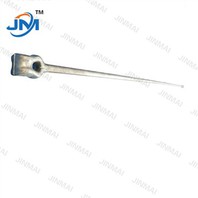
As a dedicated supplier of Galvanized Pole Hooks, I've often been asked about the elasticity of these essential tools. Elasticity, in the context of a galvanized pole hook, is a critical characteristic that affects its performance, durability, and suitability for various applications. In this blog, I'll delve into the concept of elasticity, explain its importance for galvanized pole hooks, and discuss how it impacts the overall functionality of these products.
Understanding Elasticity
Elasticity is a fundamental property of materials that describes their ability to deform under stress and return to their original shape once the stress is removed. When a force is applied to an object, it causes the object to change its shape. If the object has high elasticity, it can withstand significant deformation without permanent damage and will bounce back to its initial form when the force is no longer applied.
In the case of a galvanized pole hook, elasticity is crucial because it allows the hook to bend slightly when it comes into contact with a pole or other object. This bending action helps the hook to grip the pole more securely, reducing the risk of slipping or falling off. Additionally, the ability to return to its original shape ensures that the hook maintains its structural integrity over time, even after repeated use.
Importance of Elasticity in Galvanized Pole Hooks
The elasticity of a galvanized pole hook plays a vital role in several aspects of its performance:
1. Grip and Stability
A hook with the right amount of elasticity can conform to the shape of the pole, providing a tight and secure grip. This is especially important in applications where the hook needs to hold heavy loads or where there is a risk of the hook being dislodged by external forces. For example, in electrical line work, a galvanized pole hook is used to support cables and equipment. If the hook does not have sufficient elasticity, it may not be able to grip the pole firmly, which could lead to the cables or equipment falling and causing damage or injury.
2. Durability
Elasticity helps to absorb shock and stress, which can prevent the hook from breaking or deforming permanently. When a hook is subjected to sudden impacts or excessive loads, its elastic properties allow it to stretch and bend without fracturing. This means that the hook can withstand harsh working conditions and last longer, reducing the need for frequent replacements.
3. Versatility
Galvanized pole hooks with good elasticity can be used in a wide range of applications. They can be easily adjusted to fit different pole sizes and shapes, making them suitable for various industries, including telecommunications, construction, and utilities. Whether you need to hang a small tool or support a large cable, an elastic galvanized pole hook can provide the flexibility and reliability you need.
Factors Affecting the Elasticity of Galvanized Pole Hooks
Several factors can influence the elasticity of a galvanized pole hook:
1. Material
The type of material used to manufacture the hook is one of the most significant factors affecting its elasticity. Galvanized steel is a popular choice for pole hooks because it combines strength, durability, and corrosion resistance. The quality of the steel and its composition can impact the hook's elastic properties. For example, steel with a higher carbon content may be more rigid and less elastic, while steel with a lower carbon content may be more flexible.
2. Design
The design of the hook also plays a role in its elasticity. Hooks with a thinner cross-section or a more curved shape are generally more elastic than those with a thicker cross-section or a straight shape. Additionally, the presence of any bends, curves, or notches in the hook can affect its ability to deform and return to its original shape.
3. Manufacturing Process
The manufacturing process used to produce the hook can also influence its elasticity. For example, heat treatment can be used to improve the strength and elasticity of the steel. Quenching and tempering, in particular, can enhance the hook's mechanical properties, making it more resistant to deformation and breakage.
Testing the Elasticity of Galvanized Pole Hooks
To ensure that our galvanized pole hooks meet the highest standards of quality and performance, we conduct rigorous testing to measure their elasticity. One common method of testing is the tensile test, which involves applying a gradually increasing force to the hook until it reaches its breaking point. During the test, we measure the amount of deformation that occurs and calculate the hook's elastic modulus, which is a measure of its stiffness.
Another method of testing is the bend test, which involves bending the hook to a specific angle and then releasing it to see if it returns to its original shape. This test helps us to evaluate the hook's ability to withstand deformation and its elastic recovery properties.


Applications of Galvanized Pole Hooks
Galvanized pole hooks are used in a variety of industries and applications, including:
1. Telecommunications
In the telecommunications industry, galvanized pole hooks are used to support cables and equipment on telephone poles and cell towers. They provide a secure and reliable way to hang cables, antennas, and other devices, ensuring that they are properly positioned and protected from the elements.
2. Construction
In construction, galvanized pole hooks are used to hang tools, equipment, and materials from scaffolding, poles, and other structures. They are also used to support temporary structures, such as fences and barriers.
3. Utilities
In the utilities industry, galvanized pole hooks are used to maintain and repair power lines, transformers, and other electrical equipment. They are essential for safely accessing and working on poles and other structures, reducing the risk of accidents and injuries.
Related Products
In addition to galvanized pole hooks, we also offer a range of other products that are commonly used in conjunction with them, such as Stay Rod Stay Plate, Pole Line Hardware Forged Thimble Eye, and Hot Dip Galvanized Strand Ground Clamps. These products are designed to work together to provide a complete solution for your pole line hardware needs.
Contact Us for Procurement
If you are in the market for high-quality galvanized pole hooks or any of our other products, we encourage you to contact us for a detailed discussion. Our team of experts is available to answer your questions, provide technical support, and help you find the right products for your specific requirements. We are committed to providing our customers with the best possible products and services, and we look forward to the opportunity to work with you.
References
- Callister, W. D., & Rethwisch, D. G. (2014). Materials Science and Engineering: An Introduction. Wiley.
- Ashby, M. F., & Jones, D. R. H. (2012). Engineering Materials 1: An Introduction to Properties, Applications and Design. Butterworth-Heinemann.
- Budynas, R. G., & Nisbett, J. K. (2011). Shigley's Mechanical Engineering Design. McGraw-Hill.