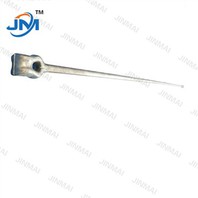
Yo, what's up everyone! As a supplier of Galvanized Pole Hooks, I often get asked about the electrical conductivity of these nifty tools. So, I thought I'd sit down and write a blog post to share what I know.
First off, let's talk a bit about what a Galvanized Pole Hook is. A Galvanized Pole Hook is a handy tool that's commonly used in the electrical and utility industries. It's typically made of metal, usually steel, and then coated with a layer of zinc through a process called galvanization. This zinc coating helps protect the hook from rust and corrosion, making it durable and long - lasting. You can check out our Galvanized Pole Hook on our website to see what I'm talking about.
Now, let's dive into the main topic: electrical conductivity. Electrical conductivity is a measure of how easily an electric current can pass through a material. Metals are generally good conductors of electricity because they have free electrons that can move around easily when an electric field is applied.
The base metal of a Galvanized Pole Hook, usually steel, is a conductor. Steel contains iron, and iron has a relatively high electrical conductivity compared to some other materials. However, when we talk about a galvanized pole hook, we have to consider the zinc coating. Zinc is also a metal, and it's a conductor too.
The zinc coating on a Galvanized Pole Hook can affect its overall electrical conductivity in a few ways. On one hand, zinc itself is a decent conductor of electricity. It has a conductivity of about 16.6×10⁶ S/m at 20°C. The steel core, on the other hand, has a conductivity that varies depending on its composition, but it's generally in the range of around 10⁷ S/m.
The presence of the zinc coating can act as an additional conductive path. In some cases, it can enhance the overall electrical conductivity of the hook, especially if the steel core has some surface imperfections or contaminants that could impede the flow of electrons. The zinc coating can provide an alternative route for the current to flow, bypassing any potential obstacles on the steel surface.


However, the thickness of the zinc coating can also play a role. If the zinc coating is too thick, it might introduce some additional resistance. This is because the zinc has a different conductivity than the steel core, and a thick layer of zinc could act like a resistor in the electrical circuit. But in most cases, the zinc coating on a Galvanized Pole Hook is thin enough that it doesn't significantly reduce the overall conductivity.
Another factor to consider is the environment in which the Galvanized Pole Hook is used. If the hook is exposed to moisture or other corrosive substances, the zinc coating will start to react. This reaction forms a layer of zinc oxide or other zinc compounds on the surface. These compounds are generally poor conductors of electricity. So, over time, if the zinc coating is corroded, it could potentially reduce the electrical conductivity of the hook.
In practical applications, the electrical conductivity of a Galvanized Pole Hook is usually sufficient for most tasks. For example, in the installation and maintenance of electrical lines, the hook is mainly used for mechanical support and handling. While it may carry some electrical current, it's not typically the primary conductor in the electrical system.
If you're working in a high - voltage environment, you might also be using other components like High Voltage Line Insulators. These insulators are designed to prevent the flow of electricity and protect workers and equipment from electrical hazards. The Galvanized Pole Hook, in this case, is just a tool to help with the installation and maintenance of these high - voltage systems.
We also offer Hot - dip Galvanizing Bolt which are used in conjunction with the Galvanized Pole Hooks in many applications. These bolts, like the hooks, are also galvanized to resist corrosion. Their electrical conductivity is also affected by the same factors as the hooks, with the zinc coating providing both protection and potentially some impact on the electrical properties.
So, to sum it up, the electrical conductivity of a Galvanized Pole Hook is mainly determined by the conductivity of the steel core and the zinc coating. The zinc coating can enhance conductivity in some cases by providing an additional conductive path, but a thick or corroded coating might introduce some resistance. In most practical applications, the hook has enough conductivity to do its job, but it's not the main focus of the electrical system.
If you're in the market for Galvanized Pole Hooks or other related products, we're here to help. We've got a wide range of high - quality products that are built to last. Whether you're an electrician, a utility worker, or involved in any industry that requires reliable tools, we can provide you with the right solutions. Don't hesitate to reach out if you have any questions or if you're interested in a purchase. We're always happy to have a chat and work out the best deal for you.
References:
- General knowledge of electrical conductivity of metals
- Information on galvanization processes and properties of zinc coatings