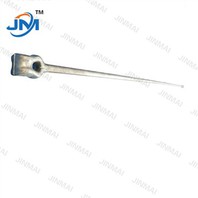
Hey there! As a supplier of steel angle cross arms, I often get asked about the fire resistance of these products. So, I thought I'd take a moment to break it down for you in a way that's easy to understand.
First off, let's talk about what a steel angle cross arm is. It's a crucial component in overhead power lines. These cross arms are used to support the conductors, keeping them at the right height and distance apart. They're made of steel, which is known for its strength and durability. But when it comes to fire, how well do they hold up?
Steel is a metal, and metals generally have a high melting point. For steel, the melting point is around 1370 - 1510 degrees Celsius (2500 - 2750 degrees Fahrenheit). This means that in normal circumstances, a steel angle cross arm can withstand a fair amount of heat before it starts to deform or melt.
However, the fire resistance of a steel angle cross arm isn't just about its melting point. There are other factors at play. For example, the thickness of the steel matters. A thicker cross arm will take longer to heat up and deform compared to a thinner one. Also, the presence of any coatings on the steel can affect its fire resistance.


Many of the steel angle cross arms we supply are Hot Dip Galvanized Overhead Line Hardware. Galvanization is a process where a layer of zinc is applied to the steel to protect it from corrosion. This zinc coating can also have an impact on fire resistance. Zinc has a lower melting point than steel, around 419.5 degrees Celsius (787.1 degrees Fahrenheit). When exposed to high heat, the zinc layer will start to melt and vaporize. This process can actually help to slow down the heating of the underlying steel, providing some additional fire protection.
Another thing to consider is the environment in which the steel angle cross arm is installed. If it's in an area where there's a high risk of fire, like near a forest or an industrial area with flammable materials, the fire resistance becomes even more important. In such cases, additional fire - protection measures might be necessary.
Now, let's talk about how we test the fire resistance of our steel angle cross arms. We follow industry - standard testing procedures. These tests involve subjecting the cross arms to controlled heat sources and monitoring how they respond. We measure things like the time it takes for the cross arm to start deforming, the temperature at which it loses its structural integrity, and how the coating behaves under heat.
Based on our testing, we can say that our steel angle cross arms offer a good level of fire resistance. But it's important to note that no material is completely fire - proof. In a severe fire, even steel will eventually succumb to the heat.
When it comes to using steel angle cross arms in areas with a fire risk, it's a good idea to pair them with other fire - resistant components. For example, Hot Dip Galvanized Secondary Clevis can be used in combination with the cross arms. These clevises are also made of galvanized steel and add to the overall stability and fire - resistance of the overhead line system.
In addition, proper installation and maintenance are key. A well - installed steel angle cross arm will be more likely to perform well in a fire situation. Regular inspections can help to identify any potential issues, such as corrosion or damage to the coating, which could affect the fire resistance.
If you're involved in Electric Power Stringing, you know how important it is to have reliable and fire - resistant components. Our steel angle cross arms are designed to meet the needs of the power industry, providing both strength and a good level of fire protection.
So, if you're looking for high - quality steel angle cross arms with good fire resistance, you've come to the right place. We're committed to providing products that meet the highest standards. Whether you're working on a small - scale power project or a large - scale transmission line, our cross arms can be a great choice.
If you have any questions about our steel angle cross arms, their fire resistance, or how they can fit into your project, don't hesitate to reach out. We're here to help you make the best decision for your power - line needs. Let's start a conversation about your requirements and see how we can work together to get the job done right.
References
- Industry standards for testing the fire resistance of steel components
- Research on the properties of galvanized steel under high - temperature conditions
- Case studies of overhead power line systems in fire - prone areas