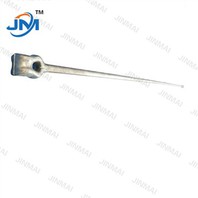
As a supplier of Steel Angle Cross Arms, I often encounter various technical inquiries from our customers. One of the most common questions is about the heat transfer coefficient of a steel angle cross arm. In this blog post, I'll delve into this topic, explaining what the heat transfer coefficient is, how it applies to steel angle cross arms, and why it matters in practical applications.
Understanding the Heat Transfer Coefficient
The heat transfer coefficient, often denoted as "h," is a measure of the ability of a material or a surface to transfer heat between a solid and a fluid (such as air or water) in contact with it. It is defined as the rate of heat transfer per unit area per unit temperature difference between the solid surface and the fluid. The SI unit for the heat transfer coefficient is watts per square meter per kelvin (W/(m²·K)).
Mathematically, the heat transfer rate (Q) can be calculated using Newton's law of cooling:
[ Q = h \times A \times \Delta T ]
where:
- ( Q ) is the heat transfer rate (in watts, W)
- ( h ) is the heat transfer coefficient (in W/(m²·K))
- ( A ) is the surface area through which heat is transferred (in square meters, m²)
- ( \Delta T ) is the temperature difference between the solid surface and the fluid (in kelvin, K)
The heat transfer coefficient depends on several factors, including the properties of the material, the fluid flow conditions (such as laminar or turbulent flow), the geometry of the surface, and the temperature difference.
Heat Transfer Coefficient of Steel Angle Cross Arms
Steel angle cross arms are typically made of carbon steel, which has relatively good thermal conductivity. The heat transfer coefficient of a steel angle cross arm is influenced by the following factors:
Material Properties
Carbon steel has a thermal conductivity (k) in the range of approximately 40 - 50 W/(m·K) at room temperature. This relatively high thermal conductivity allows heat to be conducted through the steel cross arm efficiently. However, the heat transfer coefficient also depends on how well the heat can be transferred from the steel surface to the surrounding air.
Surface Geometry
The shape and size of the steel angle cross arm affect the heat transfer coefficient. A larger surface area provides more area for heat transfer, which can increase the overall heat transfer rate. Additionally, the presence of fins or other surface enhancements can increase the effective surface area and improve heat transfer.
Air Flow Conditions
The heat transfer coefficient is significantly influenced by the air flow around the steel angle cross arm. In natural convection, where air moves due to buoyancy forces caused by temperature differences, the heat transfer coefficient is relatively low. For example, the heat transfer coefficient for natural convection of air over a flat plate can range from about 5 - 25 W/(m²·K).
In forced convection, where air is forced to flow over the cross arm by a fan or wind, the heat transfer coefficient can be much higher. Forced convection can increase the heat transfer coefficient to values in the range of 25 - 200 W/(m²·K) or even higher, depending on the air velocity and other factors.
Temperature Difference
The temperature difference between the steel angle cross arm and the surrounding air also affects the heat transfer coefficient. Generally, a larger temperature difference leads to a higher heat transfer rate, but the relationship between the heat transfer coefficient and the temperature difference is complex and depends on the flow conditions.
Importance of the Heat Transfer Coefficient in Practical Applications
The heat transfer coefficient of a steel angle cross arm is important in several practical applications, especially in electrical power transmission and distribution systems.
Electrical Equipment Cooling
Steel angle cross arms are often used to support electrical conductors and equipment in overhead power lines. These electrical components generate heat during operation, and the heat needs to be dissipated to prevent overheating. A higher heat transfer coefficient allows the steel angle cross arm to transfer heat more effectively to the surrounding air, helping to keep the electrical equipment within a safe operating temperature range.
Structural Integrity
Excessive heat can cause thermal expansion of the steel angle cross arm, which may lead to mechanical stresses and potential damage to the structure. By ensuring efficient heat transfer, the heat transfer coefficient helps to maintain the structural integrity of the cross arm and the overall power line system.
Energy Efficiency
In power transmission and distribution systems, energy losses due to heat generation in electrical components can be significant. A higher heat transfer coefficient can reduce the temperature of the electrical equipment, which in turn can reduce energy losses and improve the overall energy efficiency of the system.
Our Steel Angle Cross Arms and Heat Transfer Performance
As a supplier of Steel Angle Cross Arms, we understand the importance of heat transfer performance in our products. Our steel angle cross arms are designed and manufactured to optimize the heat transfer coefficient through the following measures:
High - Quality Materials
We use high - quality carbon steel with excellent thermal conductivity to ensure efficient heat conduction within the cross arm.
Surface Treatment
Our cross arms are often Hot Dip Galvanized Overhead Line Hardware, which not only provides corrosion protection but also has a smooth surface that can enhance heat transfer. The hot - dip galvanizing process forms a zinc coating on the steel surface, which has good thermal properties and can improve the heat transfer coefficient.
Aerodynamic Design
We design our steel angle cross arms with an aerodynamic shape to promote better air flow around the cross arm. This helps to increase the heat transfer coefficient by improving forced convection.
Related Products and Applications
In addition to steel angle cross arms, we also offer a range of related products, such as Hot Dip Galvanized Secondary Clevis and products for Electric Power Stringing. These products are all designed to meet the high - quality and performance requirements of electrical power transmission and distribution systems.


Contact Us for Procurement and Consultation
If you are interested in our Steel Angle Cross Arms or have any questions about heat transfer coefficients or other technical aspects, we encourage you to contact us for procurement and consultation. Our team of experts is ready to provide you with detailed information and support to meet your specific needs.
References
- Incropera, F. P., DeWitt, D. P., Bergman, T. L., & Lavine, A. S. (2007). Fundamentals of Heat and Mass Transfer (6th ed.). Wiley.
- Holman, J. P. (2010). Heat Transfer (10th ed.). McGraw - Hill.