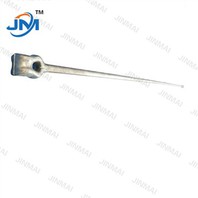
As a supplier of Steel Angle Cross Arms, I am well - versed in the common specifications of this essential overhead line hardware. In this blog, I will delve into the details of these specifications, which are crucial for ensuring the safety, efficiency, and durability of power transmission and distribution systems.
Material and Coating
The primary material for Steel Angle Cross Arms is usually carbon steel. Carbon steel offers high strength and good machinability, making it suitable for the demanding conditions of overhead power lines. For enhanced corrosion resistance, most Steel Angle Cross Arms are hot - dip galvanized. This process involves immersing the steel in a bath of molten zinc, creating a thick, protective layer on the surface of the steel.
Hot dip galvanized Steel Angle Cross Arms are highly resistant to rust and corrosion, even in harsh environmental conditions such as high humidity, salt - laden air near coastal areas, or industrial settings with high levels of pollutants. This is why hot dip galvanized Steel Angle Cross Arms are widely used in power transmission and distribution projects. You can find more information about Hot Dip Galvanized Overhead Line Hardware on our website.
Dimensions
The dimensions of Steel Angle Cross Arms vary depending on the specific application and the requirements of the power line. The two most common dimensions to consider are the length and the size of the angle section.
Length
The length of a Steel Angle Cross Arm typically ranges from 1.5 meters to 6 meters. Shorter cross arms are often used in low - voltage distribution lines, where the distance between the conductors is relatively small. For example, in a residential area with a low - voltage power supply, a 1.5 - 2.5 - meter cross arm may be sufficient.
On the other hand, high - voltage transmission lines require longer cross arms to maintain a safe distance between the conductors and to provide enough space for insulators and other hardware. In some high - voltage transmission projects, cross arms with lengths of 4 - 6 meters are commonly used.
Angle Section Size
The size of the angle section is another important dimension. The angle section is usually specified by the length of its two legs and the thickness of the steel. Common angle sizes for Steel Angle Cross Arms range from 50x50x5 mm to 125x125x10 mm.
Smaller angle sections are used in lighter - duty applications, such as in rural low - voltage distribution lines. Larger angle sections are required for heavier loads, such as in high - voltage transmission lines or in areas with high wind or ice loads. The choice of angle section size also depends on the number of conductors that the cross arm needs to support.
Load - Bearing Capacity
The load - bearing capacity of a Steel Angle Cross Arm is a critical specification. It refers to the maximum weight and force that the cross arm can safely support without deformation or failure. The load - bearing capacity is determined by several factors, including the material strength, the dimensions of the cross arm, and the way it is installed.
Dead Load
The dead load includes the weight of the conductors, insulators, and any other hardware attached to the cross arm. The weight of the conductors depends on their type, size, and length. For example, aluminum conductors are lighter than copper conductors of the same size. The insulators also contribute to the dead load, and their weight varies depending on their type and size.
Live Load
The live load is mainly caused by wind, ice, and other environmental factors. Wind can exert a significant lateral force on the cross arm and the conductors, especially in areas with high - wind speeds. Ice accumulation on the conductors can increase their weight, putting additional stress on the cross arm.
When designing and selecting a Steel Angle Cross Arm, engineers need to calculate the total load (dead load + live load) and ensure that the cross arm has sufficient load - bearing capacity. Our Steel Angle Cross Arms are designed to meet or exceed the industry standards for load - bearing capacity, ensuring the safety and reliability of the power line.
Mounting and Installation
Steel Angle Cross Arms are typically mounted on poles using bolts or other fastening methods. The mounting holes on the cross arm are carefully designed to ensure a secure and stable connection to the pole. The spacing and size of the mounting holes are standardized to fit different types of poles.
Pole Compatibility
The cross arm must be compatible with the type and size of the pole. Common pole materials include wood, concrete, and steel. Each type of pole has its own characteristics, and the mounting method may need to be adjusted accordingly. For example, when mounting a cross arm on a wooden pole, special bolts or lag screws may be used to ensure a tight connection.
Installation Orientation
The orientation of the cross arm is also important. It should be installed horizontally and level to ensure that the conductors are properly spaced and supported. During installation, care must be taken to align the cross arm correctly and to tighten the bolts to the specified torque. Incorrect installation can lead to uneven loading on the cross arm, which may cause premature failure.
Applications
Steel Angle Cross Arms are widely used in various power transmission and distribution applications.
Low - Voltage Distribution Lines
In low - voltage distribution lines, Steel Angle Cross Arms are used to support the conductors that supply electricity to residential and commercial buildings. They are usually shorter and have a relatively lower load - bearing capacity compared to those used in high - voltage transmission lines.
High - Voltage Transmission Lines
High - voltage transmission lines require Steel Angle Cross Arms with larger dimensions and higher load - bearing capacities. These cross arms are used to support the high - voltage conductors over long distances, often spanning across different terrains.
Electric Power Stringing
During the process of electric power stringing, Steel Angle Cross Arms play a crucial role in providing a stable support structure for the conductors. They help to maintain the proper tension and spacing of the conductors, ensuring the efficient and safe transmission of electricity.
If you are in need of high - quality Steel Angle Cross Arms for your power transmission or distribution project, we are here to assist you. Our products are manufactured to the highest standards, with strict quality control measures in place to ensure their performance and reliability. Whether you need a standard - sized cross arm or a custom - designed solution, we can meet your specific requirements.
Contact us today to discuss your project needs and to start the procurement process. We look forward to partnering with you to provide the best Steel Angle Cross Arm solutions for your power infrastructure.


References
- Electrical Power Systems Engineering Handbook.
- National Electrical Safety Code (NESC).
- Standards and specifications of relevant electrical industry associations.