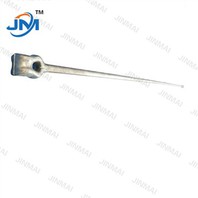
Hey there! As a supplier of ADSS Cable Hardware, I've gotten a ton of questions about the different components and their functions. One question that pops up a lot is, "What is the function of the guy wire in ADSS cable hardware?" Well, let's dive right into it.
Basics of ADSS Cable Hardware
Before we talk about guy wires, let's quickly go over what ADSS cable hardware is. ADSS, or All-Dielectric Self-Supporting, cables are used for telecommunication purposes, especially in areas where there's a need for a lightweight, self-supporting cable that can be installed in existing power line corridors. The hardware for these cables includes various components like Pole Line Hardware Forged Thimble Eye, Pin Type Insulator, and Hot-dip Galvanizing Bolt. Each component plays a crucial role in ensuring the cable's proper installation and long - term performance.
What is a Guy Wire?
A guy wire, also known as a guy rope, guy line, or stay wire, is a tensioned cable or wire rope. It's used to provide additional support to structures, in this case, the poles that hold up the ADSS cables. These wires are typically attached to the top or upper part of a pole and then anchored to the ground at a certain distance from the pole.
The Functions of Guy Wires in ADSS Cable Hardware
1. Structural Stability
One of the primary functions of guy wires in ADSS cable hardware is to enhance the structural stability of the poles. ADSS cables can be quite long, and they exert a significant amount of horizontal and vertical forces on the poles. Without proper support, these forces can cause the poles to lean or even topple over. Guy wires counteract these forces by providing a counter - tension. They distribute the load from the cable more evenly across the pole and the ground, preventing excessive stress on the pole and keeping it upright.
For example, in areas with high winds or heavy snowfall, the additional stress on the poles can be substantial. The guy wires act as a safety net, ensuring that the poles can withstand these harsh environmental conditions. Even during normal operation, the weight of the cable and the wind pressure can gradually wear down the poles. Guy wires help to reduce this wear and tear, extending the lifespan of the poles.
2. Wind Resistance
Wind is a major factor that can affect the stability of ADSS cable installations. Strong winds can push the cables and poles, creating a lateral force that may cause the poles to bend or break. Guy wires are designed to resist this wind - induced lateral force. They act as anchors, holding the poles firmly in place.
When the wind blows, the guy wires on the windward side of the pole are put under tension, while the ones on the leeward side are relaxed. This dynamic tensioning helps to keep the pole in a vertical position. The angle at which the guy wires are installed is also crucial. By adjusting the angle, we can optimize the wind - resistance capacity of the guy wire system.
3. Earthquake Resistance
In seismic - prone areas, the importance of guy wires becomes even more evident. Earthquakes can cause the ground to shake violently, which can lead to the displacement of poles. Guy wires help to secure the poles to the ground, reducing the risk of pole collapse during an earthquake.
During an earthquake, the ground movement can create complex forces on the poles. The guy wires act as a flexible yet strong connection between the pole and the ground. They can absorb and dissipate some of the seismic energy, protecting the ADSS cable infrastructure from severe damage.
4. Cable Sag Control
Another important function of guy wires is to control the sag of the ADSS cables. The sag of a cable is the vertical distance between the lowest point of the cable and the straight line connecting its two ends. Excessive sag can lead to problems such as reduced clearance between the cable and the ground or other objects, which can be a safety hazard.
By providing additional support to the poles, guy wires help to maintain the proper tension in the cables. This, in turn, helps to control the sag. When the poles are stable, the cables can be installed with the correct tension, ensuring that the sag remains within the acceptable range.
Types of Guy Wires and Their Applications in ADSS Cable Hardware
There are different types of guy wires used in ADSS cable hardware, each with its own characteristics and applications.
1. Single Guy Wires
Single guy wires are the simplest type. They consist of a single wire rope attached to a pole and anchored to the ground. These are often used in areas with relatively low wind and seismic activity. They are cost - effective and easy to install, making them a popular choice for small - scale ADSS cable installations.
2. Multiple Guy Wires
In more challenging environments, multiple guy wires are used. These can be arranged in a variety of configurations, such as a V - shape or an X - shape. Multiple guy wires provide greater stability and wind resistance. They can distribute the load more evenly across the pole and the ground, making them suitable for large - scale ADSS cable projects in areas with high wind speeds or seismic activity.
Installation and Maintenance of Guy Wires
Proper installation and maintenance of guy wires are crucial for their effective functioning. During installation, it's important to ensure that the guy wires are properly tensioned. Over - tensioning can cause the wires to break, while under - tensioning can render them ineffective.
The anchors used to secure the guy wires to the ground also need to be installed correctly. They should be buried deep enough to provide sufficient holding power. Regular inspections of the guy wires are also necessary. We need to check for signs of corrosion, wear, and damage. Any damaged guy wires should be replaced immediately to ensure the continued safety and stability of the ADSS cable installation.
Conclusion
In conclusion, guy wires are an essential component of ADSS cable hardware. They play a vital role in providing structural stability, wind and earthquake resistance, and cable sag control. As a supplier of ADSS cable hardware, I understand the importance of these components in ensuring the reliable operation of telecommunication networks.
If you're involved in an ADSS cable project or are looking to upgrade your existing installation, I'd love to have a chat with you. Whether you need more information about guy wires or any other ADSS cable hardware components, I'm here to help. Contact me to start a conversation about your procurement needs, and let's work together to find the best solutions for your project.


References
- Electrical Transmission and Distribution Reference Book, Westinghouse Electric Corporation
- Telecommunication Cable Installation Manual, Industry Standard Publication