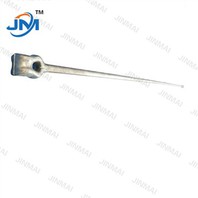
Hey there! As a supplier of Pigtail Eye Bolts, I often get asked all sorts of questions about these nifty little hardware items. One question that pops up quite a bit is, "What is the modulus of elasticity of a pigtail eye bolt?" Well, let's dive right into it and break it down in a way that's easy to understand.
First off, let's talk about what the modulus of elasticity actually is. In simple terms, it's a measure of how much a material will stretch or compress when a force is applied to it. You can think of it as a material's "stiffness." A higher modulus of elasticity means the material is stiffer and will deform less under a given force, while a lower modulus means it's more flexible and will stretch or compress more.


For pigtail eye bolts, the modulus of elasticity is an important property because it affects how the bolt will perform under load. When you're using a pigtail eye bolt to secure something, you want to know how much it can stretch or bend before it fails. This is especially crucial in applications where safety is a concern, like in construction or electrical work.
The modulus of elasticity of a pigtail eye bolt depends on a few factors, mainly the material it's made from. Pigtail eye bolts can be made from a variety of materials, including steel, stainless steel, and brass. Each of these materials has a different modulus of elasticity.
Steel is one of the most common materials for pigtail eye bolts. It's strong, durable, and relatively inexpensive. The modulus of elasticity for steel typically ranges from about 200 to 210 gigapascals (GPa). This high modulus means that steel pigtail eye bolts are quite stiff and can withstand a lot of force without deforming too much.
Stainless steel is another popular choice. It has the added benefit of being corrosion-resistant, which makes it ideal for outdoor or wet environments. The modulus of elasticity for stainless steel is similar to that of regular steel, usually around 190 to 200 GPa.
Brass is a softer material compared to steel and stainless steel. It has a lower modulus of elasticity, typically around 100 to 110 GPa. Brass pigtail eye bolts are more flexible and are often used in applications where a little bit of give is needed, like in some types of electrical connections.
Now, let's talk about why knowing the modulus of elasticity of a pigtail eye bolt matters in real-world applications. Say you're working on an electrical installation, and you need to use pigtail eye bolts to secure cables to a pole. You want to make sure that the bolts can handle the tension of the cables without stretching too much. If you choose a bolt with a too-low modulus of elasticity, it might stretch under the load and become loose over time, which could lead to a dangerous situation.
On the other hand, if you're working on a project where you need a bolt that can flex a bit, like in a movable structure, a bolt with a lower modulus of elasticity, like a brass one, might be a better choice.
As a supplier, I always make sure to provide my customers with information about the modulus of elasticity of the pigtail eye bolts I offer. This helps them make an informed decision about which type of bolt is right for their specific application.
In addition to pigtail eye bolts, I also supply other related products, such as the Hardware Pole Line Hook, Pig tail ball head, and Cable Pole Hook. These products are all designed to work together to provide reliable solutions for various industries.
If you're in the market for pigtail eye bolts or any of our other products, I'd love to hear from you. Whether you're a contractor, an electrician, or just someone working on a DIY project, I can help you find the right hardware for your needs. Just reach out to me, and we can discuss your requirements and find the best solution for you.
In conclusion, the modulus of elasticity of a pigtail eye bolt is an important property that affects its performance under load. By understanding this property and choosing the right material for your application, you can ensure the safety and reliability of your projects. So, don't hesitate to get in touch if you have any questions or need help selecting the right pigtail eye bolt.
References
- Materials Science textbooks
- Engineering handbooks on hardware components